

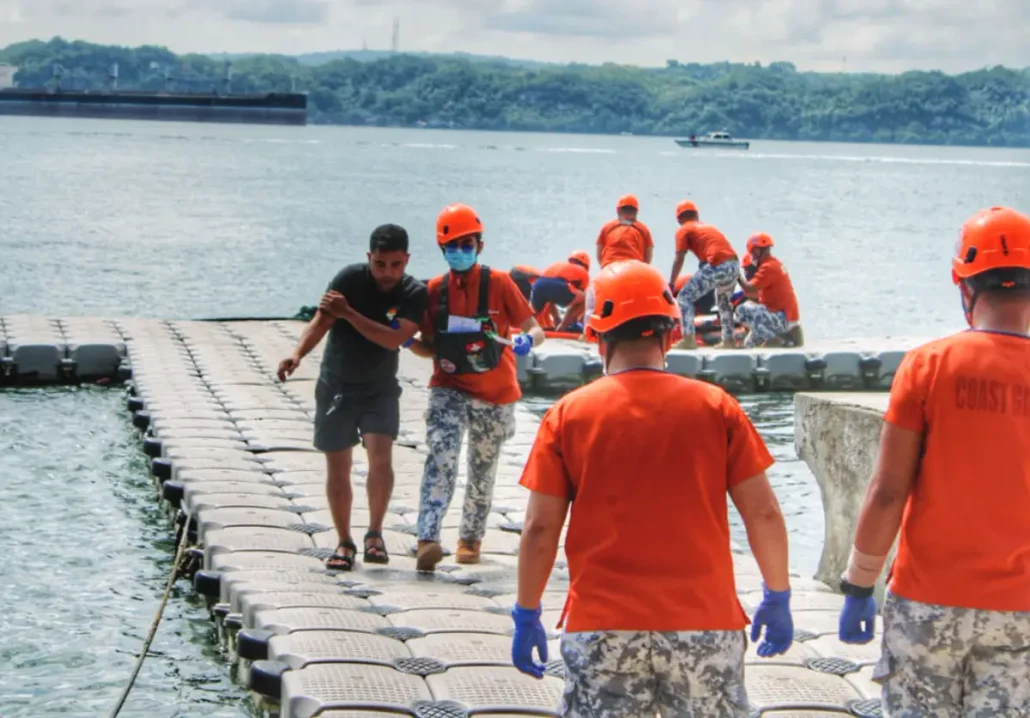
ILOILO — Communication delays emerged as a critical weakness in the Philippine Coast Guard’s emergency response system despite the successful completion of its first large-scale, multi-scenario maritime disaster exercise in the busy Iloilo-Guimaras Strait.
Coast Guard District Western Visayas (CGDWV) Commander Commodore Ludovico Librilla Jr. acknowledged the communication lapses after the exercise on Thursday, October 8, tested the ability of maritime responders to simultaneously handle a vessel collision, rescue passengers, extinguish a shipboard fire and contain an oil spill.
Although Librilla gave the exercise an impressive rating of 9.5 out of 10, he stressed that communication efficiency and faster response times must be improved to ensure that rescue operations are not compromised during actual maritime emergencies.
“Successful man ang aton nga maritime emergency response exercise. Kon sa one to 10 ang score, 9.5 ang aton nga simulation assessment kaina considering medyo delay ang aton nga communication kaina, ang radio medyo late ang paghaboy sang communication. Amo na ang dapat pa i-improve naton,” Librilla told Panay News.
Yesterday’s 1st Maritime Emergency Response Exercise 2026 mobilized eight floating assets and two local motor bancas, along with specialized medical, tactical and environmental response teams.
It was designed to assess the Coast Guard’s operational readiness, particularly its communication systems, coordination among responding units and ability to deploy emergency personnel and equipment during simultaneous maritime disasters.
Librilla emphasized that continuous training is necessary to address operational weaknesses and improve the speed of emergency response.
Simulated collision triggers multiple emergencies
The exercise simulated a potentially catastrophic collision involving a passenger banca traveling from Parola, Iloilo City, to Guimaras and a fishing vessel heading toward Iloilo Port.
Under the scenario, the passenger banca, carrying 15 passengers and five crew members, suffered complete engine failure while navigating the strait.
The disabled vessel drifted into the path of an approaching fishing banca carrying five fishermen, resulting in a collision that triggered a series of emergencies.
The passenger vessel’s captain transmitted a distress call through VHF Channel 16, prompting the Coast Guard’s Western Visayas Command Center to alert its operational command and activate an Incident Command Post.
Rescue teams aboard high-speed response boats, rubber boats and a Philippine Coast Guard Auxiliary rigid-hull inflatable boat were immediately deployed to the simulated accident site.
During the search-and-rescue phase, responders recovered two individuals who had jumped overboard and were swept away by strong waves.
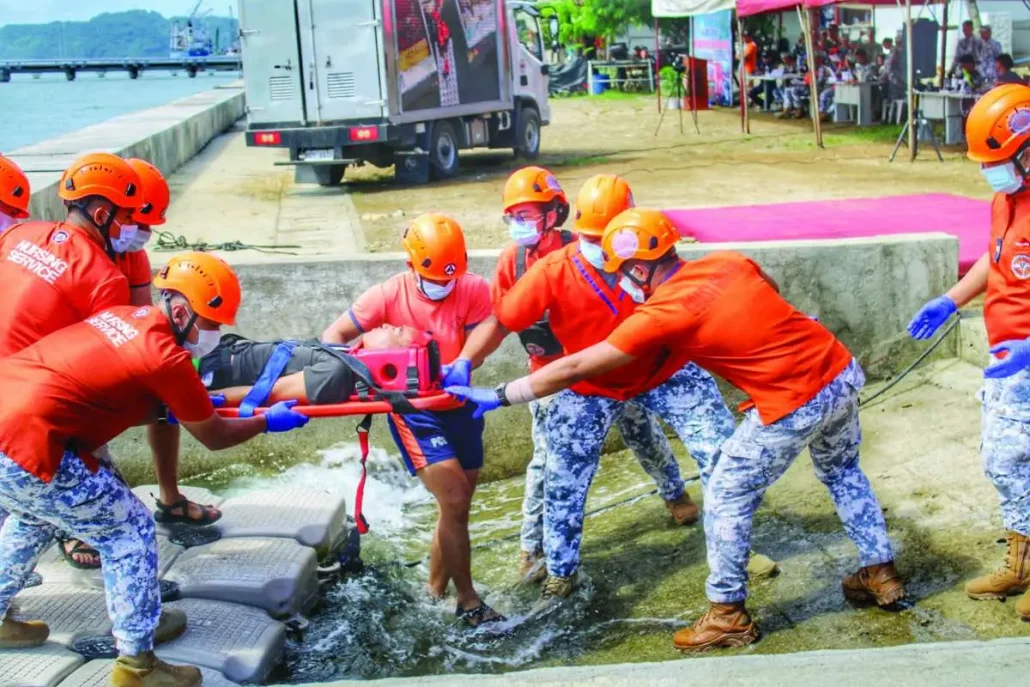
They also evacuated an unconscious passenger suffering from a head injury and another victim with minor abrasions.
Both simulated casualties were brought to a triage station at the Coast Guard district headquarters, where medical personnel provided emergency treatment before their transfer to a hospital.
The search-and-rescue phase concluded at 9:25 a.m.
Fire and oil spill test response capabilities
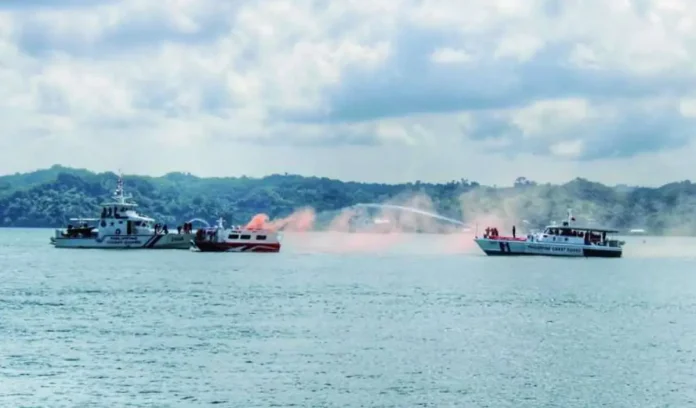
The second phase tested the Coast Guard’s ability to suppress a shipboard fire after the simulated collision damaged the passenger vessel’s fuel lines, causing leaking fuel to ignite inside its engine compartment.
The patrol gunboat BRP Kalangaman (FPB 2404), supported by other response vessels, conducted firefighting operations while a Coast Guard Station Iloilo rubber boat secured the surrounding waters and rescued a simulated burn victim.
Responders eventually extinguished the fire and established monitoring stations to prevent reignition.
The exercise also simulated the discharge of approximately 120 liters of diesel fuel into the Iloilo-Guimaras Strait, requiring the immediate deployment of marine pollution response teams.
Personnel from the Marine Environmental Protection Group-Western Visayas deployed containment booms and mechanical skimmers to prevent the simulated oil slick from spreading.
Crews demonstrated two containment techniques: a U-shaped boom configuration to restrict the movement of spilled fuel and a J-shaped configuration to concentrate the slick for mechanical recovery.
Meanwhile, shoreline assessment teams monitored nearby coastal areas to evaluate potential environmental contamination.
The three emergency scenarios were intended to determine whether the Coast Guard could coordinate multiple specialized units while maintaining effective command and communication during a complex maritime disaster.
Bigger maritime drills planned
Librilla underscored the importance of strengthening cooperation with maritime stakeholders, volunteer organizations and the Philippine Coast Guard Auxiliary, whose vessels and personnel could reinforce government responders during major emergencies.
“Gina ubra naton ini para ma-test ang response capability sang responders naton kon may incident sa tubang naton, madali kita maka-respond…i-test ang response ng units naton” he said.
He also expressed confidence in the availability of maritime assets that could be mobilized during emergencies.
“Yes, may enough kita nga floating assets…at the same time, ara man ang aton nga maritime stakeholders, mga volunteers, mga auxiliary naton nga may floating assets nga pwede naton ma magamit pag may mga muna nga sitwasyon, para at least…ara ang mga volunteers naton nga ma-augment, in case may incident nga matabo sa aton area of responsibility” he added.
Unlike previous annual exercises that concentrated primarily on rescue operations, Thursday’s drill integrated search and rescue, shipboard firefighting and marine pollution containment into a single coordinated emergency response operation.
The Coast Guard district intends to institutionalize the expanded training program and conduct more complex exercises involving larger commercial vessels.
A bigger maritime emergency exercise involving deep-draft commercial ships off Iloilo’s coast is being considered for next year.
“We are planning to conduct it again, kasi first time to now, probably next year for the province of Iloilo,” Librilla stressed.
The exercise highlighted the importance of maintaining a coordinated maritime disaster response system in the Iloilo-Guimaras Strait, where passenger boats, fishing vessels and commercial ships share busy navigation routes./PN