


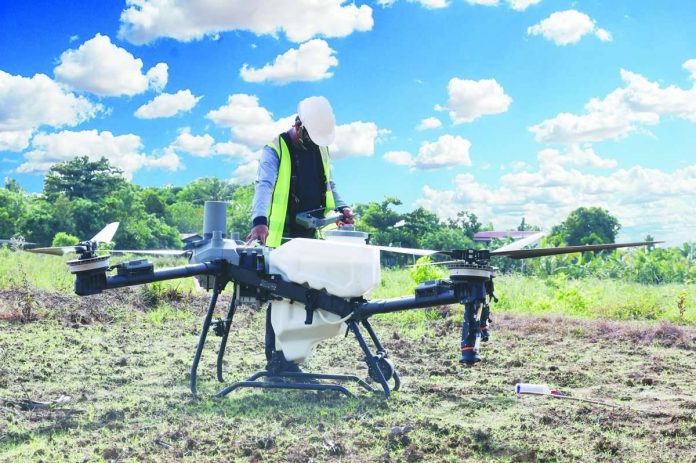
ILOILO — More than 2,100 hectares of rice fields across 16 municipalities in Iloilo Province will be cultivated using agricultural drones this wet cropping season. The Department of Agriculture (DA) is rolling out a free technology-driven farming program aimed at modernizing rice production, cutting labor costs, and boosting farmers’ productivity.
The DA has identified 2,146 hectares of rice lands as pilot areas for its Agri Drone Project under the Masagana Rice Industry Development Program’s “Napapanahon” pillar, which promotes the adoption of modern and digital technologies in agriculture.
Iloilo is currently the only province in Western Visayas covered by the drone-assisted farming services.
The project seeks to make rice farming faster, more efficient, and more precise through drone technology while improving the delivery of government services to farmers and encouraging data-driven farming practices that reduce production costs and increase yields.
According to Mark Lester Gamboa, Agriculturist II of DA Region 6, the target service area for each municipality is based on the master list of qualified farmer-beneficiaries endorsed by their respective Municipal Agriculture Offices (MAOs).
“There is no minimum or maximum landholding requirement for farmers to qualify for the drone service,” Gamboa explained.
He said all eligible rice farmers may avail themselves of the free service regardless of farm size, provided they are registered with the Registry System for Basic Sectors in Agriculture (RSBSA) and endorsed by their MAOs.
Unlike the previous implementation, which used a voucher system, this year’s rollout relies on a master listing prepared by local agriculture offices. If the project proves successful, the DA plans to expand the drone-assisted farming services to other provinces in Western Visayas during the next cropping season.
The drone operations, funded by the DA and carried out by a private service provider, include seven major services throughout the rice production cycle: molluscicide spraying, direct seeding, pre-emergence herbicide application, post-emergence herbicide spraying, insecticide application, fungicide spraying, and foliar fertilizer application.
Farmers only need to provide seeds, pesticides, fertilizers, water, and other farm inputs, while all chemicals used must be registered with the Fertilizer and Pesticide Authority.
Before every operation, farms undergo geomapping to ensure accurate flight planning and precise application of farm inputs.
Gamboa said one of the technology’s biggest advantages is speed, noting that a drone can spray one hectare in just eight to 10 minutes — far quicker than conventional manual spraying.
Drone-assisted spraying also requires only 40 to 60 liters of chemical solution per hectare compared with about 160 liters under manual application, enabling farmers to save on water, labor, and farm inputs while ensuring more uniform and calibrated application of chemicals.
“The drones are properly calibrated to ensure uniform application of inputs,” Gamboa noted, emphasizing that precision agriculture helps maximize the effectiveness of pesticides and fertilizers while minimizing wastage.
He added that drone technology also addresses labor shortages in farming communities by significantly reducing the manpower needed for field operations.
Among the pilot areas, San Miguel town has been allotted a target service area of 200 hectares this wet season.
Deneth Grace Orilla, president of the Santa Cruz Farmers Association in San Miguel, urged fellow farmers to take advantage of the government’s free drone services.
“I encourage my fellow farmers to avail themselves of the drone service of the DA. It saves time. It only takes a few minutes per hectare,” Orilla said.
The 15 other pilot areas are Concepcion, Sara, Ajuy, Barotac Viejo, Dingle, Anilao, Barotac Nuevo, New Lucena, Zarraga, Leganes, Dumangas, Igbaras, San Joaquin, Badiangan, and Pavia./PN