
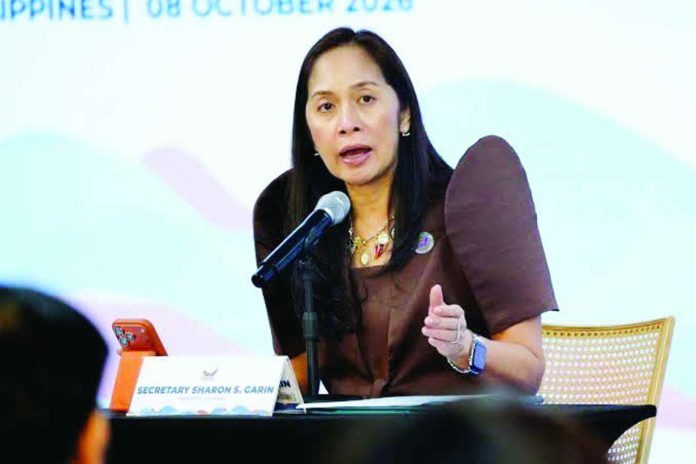
THE PHILIPPINES’ first-ever government-owned oil stockpiling tank is on track for completion by December 2027, according to Energy Secretary Sharon Garin.
“For oil, we are building the country’s first government-owned strategic petroleum reserve,” Garin said in her remarks at the Stratbase Institute’s Pilipinas Conference 2026 in Makati City last week.
“I attended the board meeting of PNOC (Philippine National Oil Company) yesterday and we are on schedule to complete the first tank ever that the government owns for stockpiling of oil… first tank will be ready by December 2027,” she said.
A national oil stockpile is a strategic reserve of crude oil and refined petroleum products maintained by the government.
It is akin to an emergency fund, but instead of cash, the government will hold millions of barrels of oil designed as buffer against sudden disruptions such as geopolitical conflicts, natural disasters, and extreme price volatility.
A national oil stockpile is different from the fuel inventories maintained by the industry, which are mandated to maintain 15 days’ worth of stock requirement.
The release of the national oil stockpile to the market could be triggered by the government when global oil supplies are choked to ensure supply continuity and prices are stable.
For the Philippines’ national oil stockpile, Garin earlier gave an indicative cost and timeline, but said that an estimated P5 billion would be needed to build a system that would carry some 500,000 to one million barrels.
“Eventually, we will complete the whole complex for one million barrels of oil,” Garin said.
She added: “But there is enough space to extend this one million barrels… [it is] about five days. But the area can accommodate 60 days.”
To scale the Bataan stockpiling facility toward its broader reserve potential, the Energy chief said the government is actively seeking private-sector partners to co-invest alongside PNOC.
“We are now looking for investors that are willing to invest together with PNOC in expanding the stockpiling facility that we have in Bataan…” Garin said.
Last week, the Philippines and Japan have signed an accord for the development of the country’s strategic petroleum reserves in a bid to safeguard fuel availability amid supply challenges arising from the global petroleum crisis.
The accord provides a framework for establishing systems to build, manage, and release strategic petroleum reserves, taking into account the Philippines’ fuel supply and demand requirements, market conditions, and the need for effective emergency response mechanisms. (GMA News)