

CAPIZ — There was a time when Jerry Juntado and his fellow Aeta farmers had little choice but to put their harvest on their backs and walk.
Corn. Sweet potatoes. Coconuts. Bananas. Cassava.
Whatever the land yielded had to be carried across rugged, unpaved roads from their remote community in Dumarao, Capiz — a punishing journey that turned every harvest into another test of endurance.
“Life was extremely difficult back then because there were no proper roads, and we often had to carry our goods to town,” Jerry recalls.
For generations, the Indigenous Peoples living in Barangays Tamulalod and Aglalana survived largely through their own labor, cultivating ancestral lands in Tamulalod, Bungsu-an and Aglalana.
Their lives revolved around the soil: planting, waiting, harvesting and finding ways to bring their produce to market.
Today, however, something has changed.
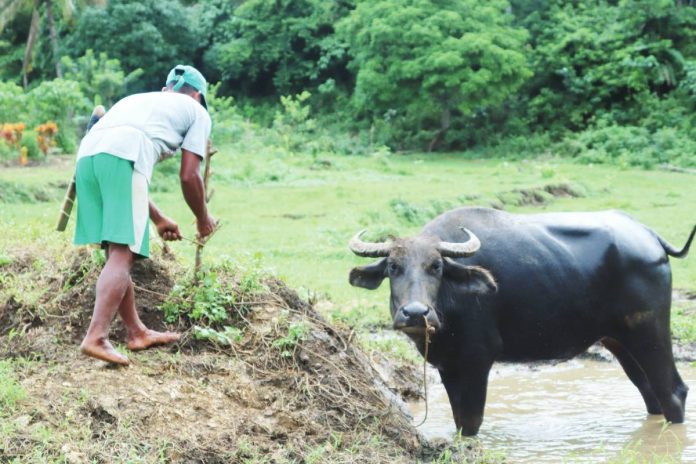
Jerry still works the land. He still wakes to the demands of farming. But beside him now is an animal that, to outsiders, may appear ordinary.
To his community, the carabao represents something much bigger.
It plows fields. It generates income. Some provide milk. And, perhaps more importantly, it stands as a living reminder that years of organizing, asking government to listen and refusing to accept poverty as permanent can bear fruit.
“One carabao is for milking, and the other is used for plowing,” Jerry explains.
When poverty threatened the next generation
The struggle in Dumarao was never only about difficult roads or exhausting farm work.
For tribal leaders, the deeper fear was that poverty was being passed from parents to children.
Tribe Chieftain Lolita Valiencia saw families struggling even to keep their children in school.
“Life in Karibuhan is tough, and many parents struggle to even send their children to elementary school. Ten students should be in college, but they had to stop because their families couldn’t afford it. These students are the children of the tribe members, and while some manage to continue their education, many cannot. We cannot break the cycle of poverty,” said Valiencia.
That realization eventually pushed the community toward collective action.
In 2000, the IP communities began organizing themselves so their concerns could be heard in assemblies and brought before government agencies.
Guided by their elders, they approached local government units to assess their needs and eventually secured registration with the Department of Labor and Employment and the National Commission on Indigenous People.
Their efforts led to the formation of Karibuhan Kae Mi mi Aete Ki Dumarao, a federation representing the majority of Aetas in Dumarao.
The federation now encompasses 148 IP families with 377 individuals living within Dumarao’s ancestral domains.
For IP Pastor Elias Elisondo Valencia, education remains essential not only to escaping poverty but also to confronting stereotypes and ensuring that Indigenous Peoples receive equal and fair treatment.
A carabao — and an answered prayer
The community’s persistence eventually opened doors to government assistance, particularly through the Department of Agriculture – Western Visayas’ Kabuhayan at Kaunlaran ng Kababayang Katutubo or 4K Program.
The program supports Indigenous farmers and fisherfolk within their ancestral domains while recognizing indigenous knowledge, skills and practices and promoting biodiversity-friendly agriculture.
For tribe elder Marina Casten, however, the impact of government intervention can be explained much more simply.
“God’s blessing truly came to us with the carabao,” tribe elder Marina Casten shares with a smile.
She still remembers the visit of the DA 4Ks group in 2018.
The community had asked for something that many farming families could not afford on their own: carabaos.
Eventually, the request was granted.
What arrived was more than farm machinery on four legs.
It was an economic tool.
In 2020, the federation received a mechanical corn sheller and portable solar dryer worth P393,000, helping farmers improve the quality of their produce.
In 2021, they received carabaos worth P662,571.
Another carabao-based livelihood project worth P8.11 million was initiated that year for the communities of Tamulalod, Aglalana and Bungsuan under the management of the Agsirab Multi-Purpose Cooperative.
The project seeks to develop carabao milk processing, establish products and market them through the cooperative. It includes native and crossbreed female carabaos, veterinary supplies, forage planting materials, training, processing equipment and common housing equipped with a milking chute.
For Marina, owning and caring for the animals also changed the rhythm of everyday life.
“We wake up early to feed the carabao and ensure it doesn’t suffer from the scorching heat of the sun,” tribe elder Marina explains.
The responsibility is demanding, but the animals have become productive partners.
Jerry uses a carabao to plow his cornfield and also offers its services to other farmers, earning P500 per field.
“We will continue to work hard, persevere and be grateful to those who help us,” he concludes.
Growth taking root
The transformation has spread beyond carabao raising.
Government-supported livelihood activities such as ginger planting and handicraft-making have provided additional sources of income and helped cultivate a stronger sense of ownership among community members.
A 30-meter by 50-meter communal vegetable garden generated P7,000 in profit, encouraging families to expand vegetable production into their own backyards.
With technical assistance from the DA 4Ks and Municipal Agriculture staff, another communal garden is being developed to grow organic vegetables for household consumption and, eventually, additional produce for sale in the local market.
The gains may appear modest when measured individually.
But in a community where families once struggled simply to send children through elementary school, each additional source of livelihood carries significance.
Tribe Chieftain Lolita remains grateful for those who helped their community reach this point.
“I am sincerely grateful to God and to Ma’am Mimi for the significant help from the 4K’s project. We will never forget her understanding, despite her struggles,” she acknowledges.
Tamulalod Barangay Captain Jeremias Abalencio has also watched the transformation unfold.
“We support the programs of Karibuhan ki Mimi Ati ki Dumarao by attending and assisting with activities such as Feeding Programs organized by various agencies and private organizations. Some programs provide carabaos and management training from DA-4Ks. The government pays special attention to Karibuhan and I am happy for them. I see that their lives will improve and become more prosperous based on their current situation and with the help of the government,” says Abalencio.
The unfinished journey
Yet for all that has changed, the community’s story remains unfinished.
Livelihood programs can provide income. Carabaos can make farming easier. Equipment can improve production. Gardens can put food on tables and money into households.
But the Aeta elders are still seeking something more fundamental: legal security over the land that has sustained their people for generations.
They continue to appeal to government agencies for the expedited registration and awarding of their Certificate of Ancestral Domain Title (CADT).
For them, the title is not merely another government document.
It represents security, recognition and the assurance that the land their elders cultivated can remain with future generations.
The Aeta community of Dumarao has already demonstrated what can happen when people who have long lived at society’s margins organize, speak collectively and gain access to meaningful government support.
Jerry no longer has to see farming only through the memory of produce carried over unforgiving roads. A carabao now helps him cultivate his land — and earns him money when it plows somebody else’s.
Vegetables are growing. Livelihoods are expanding. A community that once worried that poverty could never be broken is beginning to see another possibility.
But their transformation will be truly secure only when the land beneath all those dreams is secure, too.
For Dumarao’s Aetas, the journey from survival to prosperity has begun.
The next challenge is ensuring that what they are building today will still belong to their children tomorrow./PN