



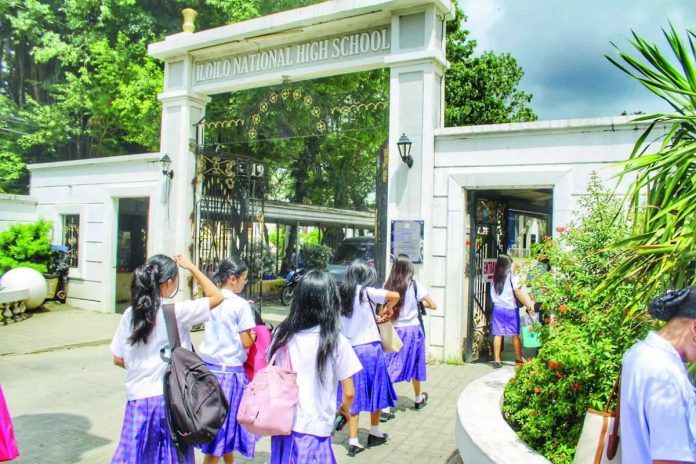
ILOILO City — Students across Western Visayas will be completely relieved of schoolwork, including home-based assignments and online learning activities, once the local heat index reaches 42 degrees Celsius, as the Department of Education (DepEd) imposes stricter safeguards against potentially life-threatening extreme heat amid the developing Super El Niño.
Under DepEd Memorandum No. 064, series of 2026, issued by Education Secretary Sonny Angara, all learning activities must be suspended when the heat index reaches the 42°C threshold, classified as the “Hinto” or danger level under the agency’s new four-tier heat response framework.
The directive goes beyond the usual suspension of face-to-face classes, requiring schools to halt even modular and asynchronous learning activities to protect students and teachers from heat-related illnesses, including dehydration, heat exhaustion and heat stroke.
DepEd Region 6 information officer Hernani Escullar Jr. confirmed that the memorandum has been disseminated to schools across Western Visayas to ensure their preparedness for the anticipated effects of Super El Niño.
“We immediately cascaded the Memorandum on the Anticipatory Action against El Niño to allow our schools to assess their readiness if ever such event will occur in our region and affect our learners and school personnel,” Escullar told Panay News.
He emphasized that the regional education office, under Regional Director Cristito A. Eco, is prioritizing the protection of students and school personnel as the region prepares for increasingly dangerous heat conditions.
“The safety, well-being, and health of our learners and personnel are of utmost priority as of the moment,” Escullar stressed.
“Next to this is the learning continuity in our schools,” Escullar added.
Classes suspended even before 42°C
Under the new policy, face-to-face classes must already be suspended when the heat index reaches 33°C to 41°C, classified as the “Hinga” or extreme caution level.
At this stage, schools must shift to home-based modules and asynchronous learning activities to maintain academic instruction without exposing students and teachers to potentially hazardous classroom conditions.
However, once the heat index climbs to 42°C or higher, all instructional activities must stop, effectively giving students a complete academic break until conditions become safer.
Escullar stressed that students should remain indoors during the “Hinto” level because exposure to extreme heat could trigger heat cramps, heat exhaustion and potentially fatal heat stroke.
The heat index measures how hot the temperature feels to the human body when air temperature and relative humidity are combined.
Four levels of heat protection
DepEd’s new 4H Heat Response Framework establishes specific measures depending on prevailing local heat conditions.
At the “Hayo” level, when the heat index is below 27°C, regular face-to-face classes may continue, with outdoor activities scheduled during cooler hours and mandatory hydration breaks.
At the “Hinay” level, from 27°C to 32°C, school heads may adjust class schedules, introduce hybrid arrangements or shift to flexible home-based learning.
The “Hinga” level, covering 33°C to 41°C, requires the suspension of in-person instruction and the transition to alternative learning arrangements.
At the highest “Hinto” level, beginning at 42°C, both classroom instruction and home-based academic requirements must be suspended.
School administrators are also authorized to modify class schedules ahead of peak afternoon temperatures based on localized weather monitoring and forecasts from the Philippine Atmospheric, Geophysical and Astronomical Services Administration (PAGASA).
Schools ordered to prepare
Beyond class suspensions, DepEd has directed schools to assess their infrastructure and readiness for prolonged extreme heat and drought.
These preparations include evaluating classroom ventilation, electrical load capacity and emergency water supplies to ensure that school facilities can withstand worsening environmental conditions.
Schools must also provide regular hydration breaks, minimize students’ exposure to direct sunlight and allow heat-appropriate clothing, including comfortable physical education uniforms.
The department likewise instructed education officials to standardize alternative delivery modes to ensure that academic requirements remain manageable without compromising student safety.
The preventive measures come amid warnings of a developing Super El Niño, which the Philippine Atmospheric Geophysical and Astronomical Services Administration (PAGASA) projects could intensify into a very strong climate phenomenon and persist through the first half of 2027.
The prolonged dry conditions could expose schools to increased heat-related health risks and disruptions to regular classroom instruction.
Angara emphasized that the framework allows schools to respond to actual conditions in their respective communities instead of imposing unnecessary disruptions across entire regions.
“Every community experiences weather conditions differently. Through our 4H framework and daily, classroom-level monitoring, we are empowering our school heads with the flexibility to adjust hours or shift to modular learning only when local conditions genuinely require it,” Secretary Angara said.
DepEd said the policy will remain effective throughout the anticipated El Niño episode unless superseded by another directive.
“This Memorandum shall remain in effect until the release of the DOST- PAGASA Final Advisory announcing the end of the 2026-2027 El Niño, or until otherwise revoked or superseded by subsequent DepEd issuances,” DepEd added.
For Western Visayas schools, the directive establishes a clear priority as extreme heat threatens to disrupt education: protecting students and teachers from dangerous heat exposure takes precedence over completing classroom lessons and academic requirements./PN