

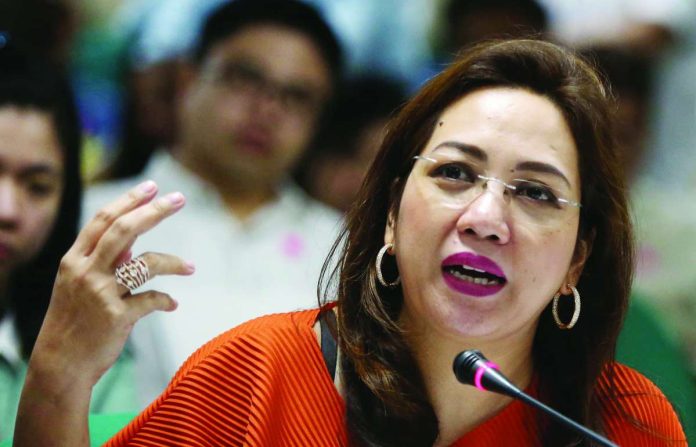
MANILA — Acquitted of graft and technical malversation charges over the controversial P3.5-billion Dengvaxia vaccine procurement, former Health Secretary and now Iloilo 1st District’s Cong. Janette Garin declared that her conscience remained clear and warned that politicizing public health decisions could discourage doctors and scientists from taking necessary actions to protect lives.
The Sandiganbayan’s Special Second Division cleared Garin and her co-accused on Tuesday, October 13, finding insufficient evidence to establish criminal liability in the procurement of dengue vaccines undertaken when she was Health Secretary during the administration of then President Benigno Simeon Aquino III.
The anti-graft court found insufficient proof that Garin acted in bad faith or with gross negligence in implementing the government’s dengue immunization program.
Welcoming the ruling after years of legal proceedings, Garin maintained that she and her fellow health officials had acted in good faith and remained confident that the evidence would establish their innocence.
“Malinis ang aking konsensya. Wala kaming itinatago, at patuloy kaming maninindigan sa katotohanan,” Garin said in an official statement.
The lawmaker emphasized that the controversy should serve as a lesson against allowing political considerations to interfere with scientific judgment, particularly in matters involving public health and vaccination.
“Hindi dapat napulitika ang kalusugan. Public health decisions must be guided by science, evidence, and the best interests of the people,” she said.
Garin, a physician and trained advanced vaccinologist, also warned that the threat of criminal prosecution could discourage medical professionals from making difficult but necessary decisions.
“Bilang isang doktor at trained advanced vaccinologist, naiintindihan ko na may mga taong tutol sa bakuna at may mga anti-vaccine advocates. Bahagi ito ng mga hamon na kinakaharap namin sa public health. But we cannot allow the threat of lawsuits to intimidate experts from doing their jobs, especially when lives are at stake and the consequences of disregarding vaccines can be serious,” she said.
She stressed that public health professionals should not be deterred from performing their responsibilities simply because their decisions could expose them to legal challenges.
“It is a consequence we sometimes have to face when we perform our duties as experts. Pero hindi dapat maging dahilan ang takot sa kaso para hindi na tayo gumawa ng mga kinakailangang desisyon para sa kalusugan ng publiko. Kapag bakuna ang pinag-uusapan, buhay ang nakataya,” Garin said.
The charges stemmed from allegations by the Office of the Ombudsman that Garin and several Department of Health (DOH) officials improperly used P3.5 billion intended to support the government’s Expanded Program for Immunization to purchase Dengvaxia vaccines.
Prosecutors alleged that funds sourced from the Miscellaneous Personnel Benefits Fund were diverted to a program for which the vaccine was not authorized.
The Ombudsman also argued that Dengvaxia was not included in Volume 1 of the Philippine National Drug Formulary, allegedly violating Executive Order No. 49, series of 1993.
Garin’s defense, however, presented documents from the Department of Budget and Management indicating that the special allotment release order specifically authorized vaccine procurement.
Her lawyers maintained that the purchase complied with government regulations and was undertaken in good faith to address the country’s dengue problem.
Also implicated in the graft case were former Health Undersecretaries Gerardo Bayugo and Kenneth Hartigan-Go, former officer-in-charge director Joyce Ducusin, and former Philippine Children’s Medical Center executive director Julius Lecciones.
All except Bayugo also faced technical malversation charges alongside Garin.
The vaccines were purchased from pharmaceutical manufacturer Sanofi Pasteur in December 2015 for a school-based dengue immunization campaign.
However, the government under then President Rodrigo Duterte suspended the program in November 2017 after Sanofi disclosed that Dengvaxia could increase the risk of severe dengue among individuals who had never previously contracted the disease.
The disclosure triggered nationwide controversy, legal complaints against former health officials, and widespread public concern over vaccine safety.
Before Tuesday’s ruling, Garin and her co-accused had sought the dismissal of the cases, arguing that their constitutional right to the speedy disposition of cases had been violated.
The Sandiganbayan rejected those motions in January 2024, also dismissing Garin’s argument that the charges improperly combined multiple offenses in a single information.
Garin had previously posted bail of P90,000 for the graft charge and P18,000 for the technical malversation charge.
She earlier described the legal ordeal as an “agonizing process” as she sought to establish her innocence and “ensure a fair trial.”
Beyond her acquittal, Garin said the Dengvaxia controversy had broader consequences for the country’s public health system, particularly the erosion of public confidence in vaccines.
She maintained that the backlash against the immunization program contributed to vaccine hesitancy and subsequent outbreaks of measles and polio.
In her statement, Garin emphasized that public health decisions must be evaluated according to the scientific evidence and information available when those decisions were made, rather than judged solely through hindsight or political controversy.
“If we make doctors afraid to make difficult public health decisions, ultimately, our patients will suffer,” Garin said.
She also described the court’s decision as an opportunity to restore public confidence in doctors, scientists, researchers, and other public health professionals whose work had come under intense scrutiny during the Dengvaxia controversy./PN