



ILOILO City – For many Iloilo transport workers, driving no longer guarantees an income.
Soaring fuel prices and steep daily vehicle rentals are eating up nearly everything jeepney and taxi drivers earn, forcing some to borrow money just to feed their families and keep their children in school — a worsening livelihood concern that pushed transport workers into the streets Tuesday, September 29, as part of a nationwide protest.
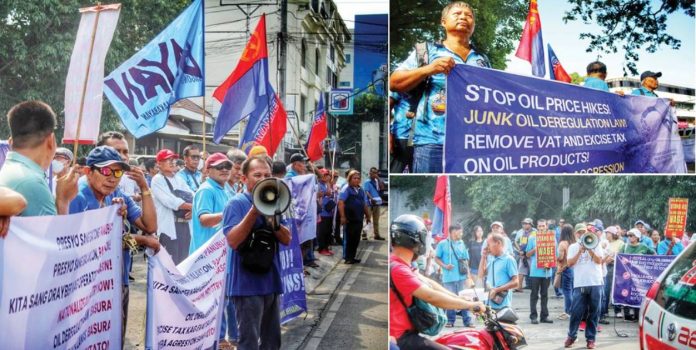
Drivers, jeepney operators and progressive groups gathered in front of a gas station in Jaro district to protest petroleum price increases which they said have pushed the transport sector closer to financial collapse.
The numbers paint a grim picture.
For 56-year-old Loreto Legarto, who has driven the San Dionisio, Iloilo – Jaro, Iloilo City route for 28 years, operating a traditional jeepney means paying P1,000 daily in vehicle rental and another P1,000 to P3,000 for diesel.
He consumes more than 20 liters of fuel daily, while a single loop requires about three liters and brings in less than P300.
Whatever is left after fuel and rental expenses becomes his take-home pay.
“Ang asawa ko sa balay lang namon. Ano pa gid mahimo namon nga pangutang lang nga pangutang para sa amon nga estudyante?” Legarto lamented.
He is supporting four children — one in college and the others in Grades 12, 10 and 8.
Legarto said the recent P1 fare increase hardly offsets the burden, particularly because drivers still have to shoulder mandated student discounts.
“Maka-trespaser bala ina? Indi. Perde na gani ang byahe namon, perdehan pa gid namon sini,” he lamented.
The financial squeeze extends beyond jeepney drivers.
Taxi driver Donnie Napacia, 64, of Lapuz district here said he pays a daily boundary of P1,100 while consuming around 13 liters of gasoline, depending on the distance traveled.
There are days, he said, when nothing is left to bring home.
“Sa pagtaas ka gatong, imbis nga isulod mo sa kaldero mo, isulod pa sa tanke mo. Grabe ang pagmahal sang gasoline. Waay man gahulag sang insakto ang gobyerno. Sakto malang sila mag uru-ayuda,” Napacia said.
He also complained that government assistance has largely favored transport cooperatives while traditional independent operators and taxi drivers receive little help.
“Ang gina-ayudahan lang puro kooperatiba. Sa mga taxi driver wala nakadumdum ang gobyerno, nagakatulog,” he stressed.
Napacia said some drivers have resorted to repeatedly borrowing from operators to survive, describing their situation as “gina–rolling-rolling lang namon.”
‘TEMPORARY ROLLBACK NOT ENOUGH’
The growing pressure on drivers fueled Tuesday’s mobilization, with transport groups and progressive organizations joining the nationwide protest against high petroleum prices.
Elmer Forro, secretary general of cause-oriented group Bagong Alyansang Makabayan – Panay and lead convenor of a transport coalition, said recent fuel price reductions were nowhere near enough to compensate for previous increases.
“Ang amon kaakig subong indi pwede paupawan sang temporary nga rollback,” Forro declared.
The coalition said recent pump price reductions of more than P7 were dwarfed by accumulated fuel price increases earlier in September that breached P18.
The protesters called for the repeal of the Oil Deregulation Law, reduction or removal of the expanded value-added tax and excise tax on petroleum products, and substantial wage increases for workers.
The groups also planned to march to the Regional Tripartite Wages and Productivity Board in Western Visayas to press for higher wages amid rising living costs.
For 64-year-old jeepney operator Rey P. Dasal, a member of the Iloilo City Jeepney Operators and Drivers Association from Balabago, Jaro, participating in the protest was a show of solidarity with fellow transport workers.
He said drivers and operators were being squeezed by both volatile fuel prices and the difficulty of keeping aging traditional jeepneys compliant with government regulations.
“Indi gid mapunggan ang saka kag naog sang gatong. Mataas, manos.. sinintimos. Perdi gid ang mga driver,” he said.
The protest is part of a two-day nationwide transport strike.
For Iloilo drivers, however, the issue goes beyond the demonstrations: every additional peso spent at the fuel pump means another peso taken away from food, education and other household necessities.
Transport groups insist that temporary fuel rollbacks and minimal fare adjustments will not resolve that squeeze, and are pressing the national government for longer-term changes in fuel taxation, pricing policy and worker incomes./PN