


ILOILO City – Western Visayas is bracing for a prolonged six-month dry period beginning this October, with a very strong El Niño threatening to trigger water shortages, drought, extreme heat and mounting pressure on agriculture and power supply through March 2027.
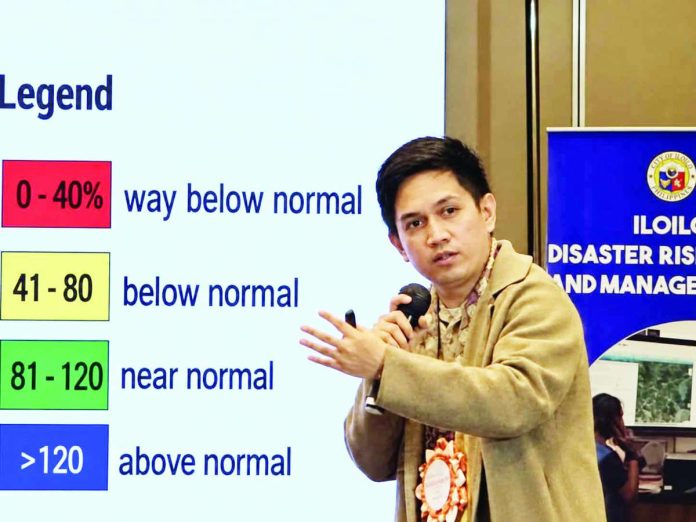
The Philippine Atmospheric, Geophysical and Astronomical Services Administration (PAGASA) warned that rainfall across the region is expected to fall below normal in October and November before deteriorating to way-below-normal levels from December 2026 to March 2027.
El Niño is the warm phase of the El Niño-Southern Oscillation (ENSO), a recurring climate pattern characterized by unusually warm sea-surface temperatures in the central and eastern equatorial Pacific Ocean. The phenomenon disrupts normal atmospheric circulation and rainfall patterns and, in the Philippines, generally increases the likelihood of below-normal rainfall, dry spells and drought in affected areas.
A “Super El Niño” is a popular term for an exceptionally intense or very strong El Niño, when warming in the tropical Pacific becomes particularly pronounced. “Super El Niño” is not a formal PAGASA classification; meteorological agencies generally describe exceptionally intense events as very strong El Niño episodes. Such events can produce stronger disruptions in rainfall and temperature patterns, although their exact effects vary by location.
Engr. Ferdinand L. Rubin Jr., weather specialist at PAGASA-Iloilo, said during a scientific forum in Iloilo City that the prolonged rainfall deficit could set off interconnected problems affecting water, food production and energy as temperatures rise.
“Water crisis is very possible. Kun kulang ang ulan. Wala clouds, so there are hotter temperatures, of course there will also a crisis sa heat,” Rubin said, adding that increased use of air-conditioning units could further strain the energy sector.
“Cascaded ‘yan. Interrelated ang mga problema sa heat,” he added.
PAGASA’s rainfall outlook indicates that drought conditions could develop across the country from January to March 2027, while Iloilo Province and Iloilo City could experience dry spell and drought conditions toward the end of the first quarter.
Rubin stressed that drought is determined by several consecutive months of deficient rainfall and not merely a single month of below-normal precipitation.
“Kung merong isang buwan na kulang ang ulan, hindi pa tayo makaka-declare ng drought. Consecutive months ‘yung tinitingnan natin,” he said.
The dry outlook covers Aklan, Antique, Capiz, Guimaras and Iloilo.
Aklan is forecast to receive 229.6 millimeters of rainfall in October, 228 mm in November and 92.3 mm in December. Antique’s projected rainfall is 188.3 mm, 115.7 mm and 60.5 mm, respectively.
Capiz could receive 251.8 mm in October and 262.8 mm in November before rainfall drops to 92 mm in December.
Guimaras faces a particularly sharp decline, from 192.7 mm in October to only 42.5 mm in November and 39.1 mm in December.
In Iloilo, including Iloilo City, rainfall is projected at 194.2 mm in October, 144.6 mm in November and only 65.5 mm in December, with further reductions expected from January to March 2027.
The projected rainfall amounts point to the possibility of sustained dry conditions, although actual rainfall could vary among localities.
PREPARE BEFORE CRISIS HITS
With the prolonged dry period looming, Iloilo City’s Mayor Raisa Treñas called for early, science-based preparations, saying local governments should not wait for the effects of Super El Niño to become a full-blown crisis.
“This is why preparedness must begin before a crisis happens,” Treñas said during the scientific forum, “Turning Foresight into Enabling Preparedness and Resilience amid the Threat of a Super El Niño.”
Treñas warned that the phenomenon could affect water supply, food production, fisheries, livelihoods and the daily lives of Ilonggos, underscoring the need to identify risks and put interventions in place early.
The city government has allocated P6 million for a delineation survey and review of waterways to determine the actual flow of water through creeks and natural waterways and identify areas requiring clearing.
The survey will also identify informal settler families occupying areas that obstruct waterways and who may have to be relocated to prevent further disruption of water flow.
“Gamay lang nga program but big impact… amo na ya ang natural nga flood control gid nga matuod-tuod,” Treñas said.
The mayor also cited existing environmental and disaster preparedness initiatives, including the I-GREENS Program for the development and maintenance of open spaces.
Other measures include mangrove rehabilitation and coastal greening, rainwater harvesting, EcoCycle waste management, SunRISE solar initiatives and the KABALAKA disaster preparedness program.
Treñas said disaster preparedness has become a personal advocacy after she experienced the devastation of Typhoon Frank in 2008.
“As a Typhoon Frank victim, this advocacy is very personal for me… We have to know what we are expecting so that we can prepare,” she said.
She said scientific information and accurate data are crucial in guiding government agencies and stakeholders as they prepare for Super El Niño and other climate-related hazards.
The forum gathered scientists, technical experts, representatives from the academe and private sector, and disaster risk reduction officials to discuss anticipated climate risks and possible responses./PN