

ILOILO City – The city government’s endorsement of Aboitiz InfraCapital’s (AIC) bulk water supply proposal could more than double water rates for consumers, according to figures from the National Irrigation Administration (NIA).
Despite NIA’s rejection of the unsolicited proposal in March, the city government granted AIC Original Proponent Status and advanced the project to a Swiss Challenge.
NIA, backed by the Asian Development Bank (ADB), said the plan conflicts with its advisory agreement with ADB for the Jalaur River Multi-Purpose Project Stage II (JRMP II), the intended water source.
The agency also cited violations of the Public-Private Partnership Code, which prohibits unsolicited proposals when a comparable government-backed project is underway.
NIA said the AIC plan competes directly with the government-to-government arrangement with the Metro Iloilo Water District (MIWD) designed to keep water affordable.
Under AIC’s Build-Own-Operate/Build-Lease model, local governments could pay availability fees of up to P27 billion over a 33-year concession period, even if actual demand is lower than projected. At the consumer level, this translates to an estimated P80 per cubic meter, which is double the current rate paid by Iloilo City households.
The MIWD–NIA–ADB scheme, pursued since 2017, is projected to supply water at a reasonable cost without imposing contingent liabilities on local governments. In July, MIWD and NIA signed a memorandum in preparation for the allocation of 1 cubic meter per second (86 million liters daily).
Higher water tariffs under the AIC proposal would add to household expenses at a time when prices of other essential goods and services are also rising. The city government has yet to explain why it is pursuing the project despite a reasonable, publicly funded alternative backed by a multilateral lender./PN
(caption)
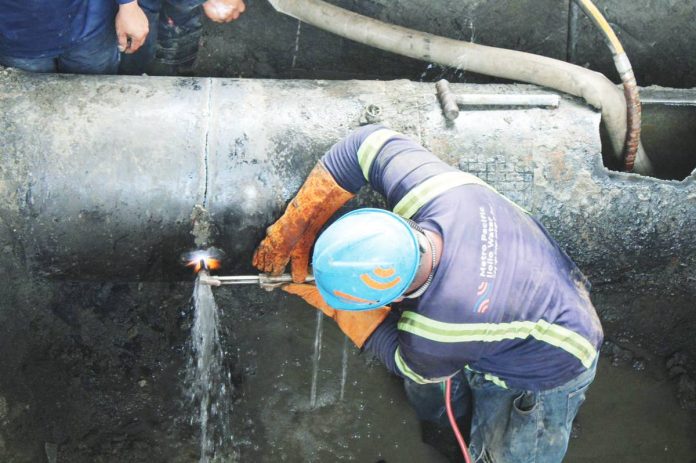
Metro Pacific Iloilo Water (MPIW) aims to reduce Non-Revenue Water (NRW) to below 25% by 2029. Currently, MPIW has reduced NRW to 47%, a significant improvement from over 60% in 2019. This reduction is achieved through various strategies including active leak detection, pipe replacement, and the use of advanced technologies like SAHARA mobile leak detection.