


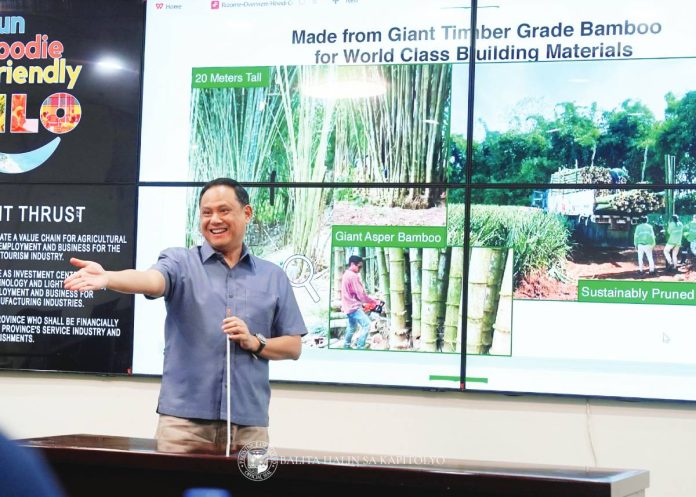
ILOILO — A bold vision to position Iloilo as Southeast Asia’s leading bamboo powerhouse by 2030 is taking shape, as the Iloilo Local Economic Development (ILED) Foundation and international firm Rizome Bamboo presented a sweeping green investment proposal to the provincial government.
Spearheaded by ILED in collaboration with Rizome, the plan seeks to build a bamboo-based green economy anchored in sustainable development, climate action, and inclusive growth.
At its heart is the establishment of a state-of-the-art engineered bamboo manufacturing plant and the monetization of Panay Island’s verified bamboo inventory through carbon credits — offering both environmental and economic value.
“This proposal could not have come at a better time,” said Gov. Arthur Defensor Jr., expressing strong support for the initiative. “It is aligned with our programs such as Turista sa Barangay and Tanum Iloilo, which focus on rural development and reforestation.”
Engineered bamboo, an environmentally friendly alternative to steel, concrete, and wood, is at the center of the initiative. Rizome’s globally recognized model for bamboo production offers a renewable material for construction, while also creating high-value employment, stimulating local entrepreneurship, and reducing carbon emissions.
The plan outlines a strategic roadmap to develop Iloilo’s bamboo industry into a globally competitive sector. This includes tapping the province’s natural resources — particularly in Maasin, already dubbed the bamboo capital of the Philippines — and converting areas under the Integrated Social Forestry Projects (ISFP), covering over 9,000 hectares, into sustainable bamboo plantations.
Rizome’s proposal also underscores the creation of new livelihood opportunities by connecting local bamboo farmers and cooperatives to the international carbon credit market. This would enable communities to earn from their contribution to climate mitigation efforts.
With the Visayas International Container Terminal (VICT) in Iloilo City providing export logistics support, the province is set to become a major export hub for engineered bamboo products, targeting global markets hungry for sustainable construction materials.
“The project opens up new markets for our micro-entrepreneurs and small farmers,” the governor added, emphasizing its potential to uplift grassroots economies while advancing environmental goals.
If realized, Iloilo’s bamboo transformation will not only create jobs, develop green enterprises, and boost exports, but also place the province at the forefront of Southeast Asia’s climate-smart economic transition./PN