



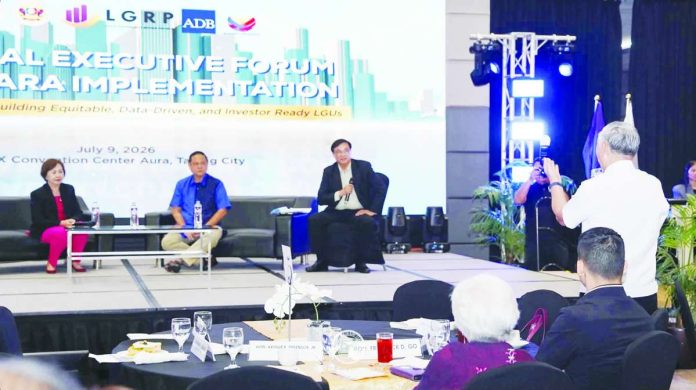
ILOILO — This province has gained national recognition as a model local government unit in implementing the Real Property Valuation and Assessment Reform Act (RPVARA), with several provinces now seeking to replicate its digital property valuation system and taxpayer-friendly reforms after Gov. Arthur Defensor Jr. presented the province’s best practices before local chief executives from across the country.
Defensor served as resource speaker during the RPVARA National Executive Forum on July 9 at the SMX Convention Center Aura in Taguig City, where he highlighted how Iloilo successfully modernized its real property valuation system while keeping tax assessments affordable for taxpayers.
The forum was organized by the Bureau of Local Government Finance under the Department of Finance and attended by Finance Secretary Frederick Go.
Republic Act No. 12001, or the RPVARA, establishes a uniform system of real property valuation nationwide and requires local government units to update their Schedules of Market Value (SMVs) to promote fairer taxation and improve revenue generation for public services.
Defensor told fellow local executives that Iloilo’s strategy focused not only on increasing revenues but also on ensuring that tax obligations remain within the capacity of Ilonggos to pay.
“Taxes should be affordable and reasonable and it must go with the taxpayers’ capacity to pay and the development of the economy,” Defensor said.
Even before the law’s enactment, Iloilo had already developed its own Province of Iloilo Assessment System (AsSys), a digital platform managed by the Provincial Assessor’s Office that centralizes assessment records of all 42 component municipalities and automates tax declarations, assessment notices, and statutory reports.
Iloilo also became Western Visayas’ pilot local government unit (LGU) for the Local Government Reform Project in 2023 and has since fully aligned its SMV updates with RPVARA requirements.
To prepare for the law’s implementation, the provincial government mobilized technical teams and intensified information gathering to determine property valuations that remain affordable for taxpayers while adopting assessment levels below the maximum limits allowed under the 1991 Local Government Code.
“Good governance begets taxation…One important thing is performance. When you are doing well, hindi ka mahihiya na humingi ng taxes. And when you ask for additional taxes, you have to justify that we need taxes for the healthcare system of our country,” the governor said.
From 2023 to 2025, Iloilo allocated P15.68 million for data cleansing of assessment records, resulting in the cancellation of 31,588 non-existent real property units, the discovery of 24,912 new structures, P101.25 million in collectibles, validation of 194,655 existing structures, and an additional P442.72 million in collectibles. The province estimates another P495.92 million in revenue by 2028 if the 2017 assessment level is retained.
BLGF executive director Consolacion Agcaoili praised Iloilo’s digitalization, data cleansing, capacity building, and community-based information campaigns, saying they demonstrate that modernization and taxpayers’ trust can go hand in hand.
Following the presentation, the provinces of Kalinga and Biliran expressed interest in benchmarking Iloilo’s best practices, with Biliran already sending a formal request for a learning visit.
Defensor was also the principal author of House Bill No. 4814 during his term as Iloilo’s 3rd District congressman, which later became the Tax Amnesty Act of 2019./PN