



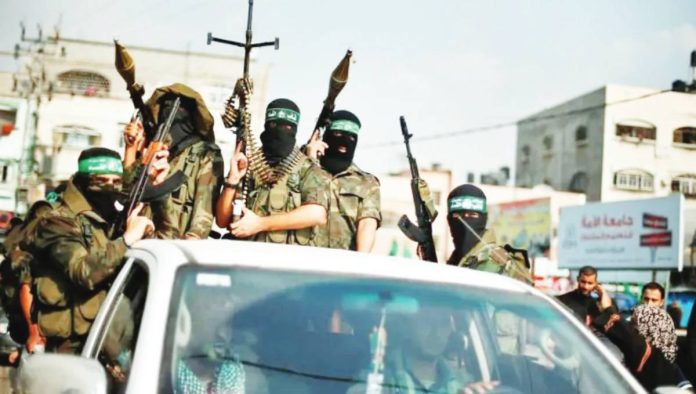
TEL AVIV — A senior Israeli official has said troops will not pull back from their current positions in Gaza without the “genuine disarmament” of Palestinian armed group Hamas in the territory.
Hamas meanwhile said handing over its heavy weapons was contingent on Israel ending “all forms of aggression” and withdrawing its forces from Gaza.
It comes after Donald Trump said the Board of Peace had reached an agreement for the “complete disarmament” of Hamas and other armed groups in Gaza.
On Friday Trump insisted that Israel was “very happy” with the proposed agreement, describing it as a “big step for the Middle East”. However far-right Israeli National Security Minister Itamar Ben Gvir dismissed the draft as “not acceptable”.
It is part of the second phase of a US-brokered Gaza ceasefire plan that aims to end the war in Gaza.
The 20-point plan, unveiled in September last year, included the creation of the Board of Peace to oversee the agreement’s implementation, as well as the disarmament of Hamas, withdrawal of Israeli troops and reconstruction of Gaza.
Speaking at a cabinet meeting at Camp David on Friday, Trump said he had an “understanding” with Israel over the latest disarmament proposal agreed with Hamas, adding that “Israel’s very happy about it”.
Asked whether Hamas would disarm before Israeli forces withdrew from Gaza or vice versa, Trump did not answer directly but said Gaza remained “a very complex situation”.
Hamas weapons would be handed over to the Board of Peace, he added.
Israeli Prime Minister Benjamin Netanyahu has not yet commented on the latest proposal.
But a senior Israeli official said the country’s position remained that “there will be no IDF [Israel Defence Forces] withdrawal from the current Yellow Line without the genuine disarmament of Hamas”.
The Yellow Line is the designated demarcation point within Gaza that Israel agreed to withdraw its forces to following the US-brokered ceasefire between Israel and Hamas last year.
The deal was meant to leave Israel in temporary control of the area behind the Yellow Line – equating to 53% of Gaza’s territory. However, the Israeli Prime Minister Benjamin Netanyahu recently said the Israel Defense Forces (IDF) controlled more than 60%. In May, he said publicly that his “directive” was to move to 70%.
In its statement, Hamas said Israel’s commitment to ending its attack on Gaza was a “fundamental prerequisite” for moving forward with the deal, as well as a guaranteed right to “self-determination, establishing an independent Palestinian state”.
The group said it had negotiated “responsibly and positively” with “national consensus among the Palestinian factions”.
Palestinian officials involved in the talks believe the decision of Hamas’s new leadership – which they described as the most consequential in the group’s history – was driven by the devastating humanitarian conditions facing more than two million Palestinians in Gaza.
Earlier on Friday, the Board of Peace published what it described as a roadmap for Gaza, reaffirming its proposal for the phased disarmament of Hamas, a gradual Israeli withdrawal and the deployment of an international stabilisation force. (BBC)