



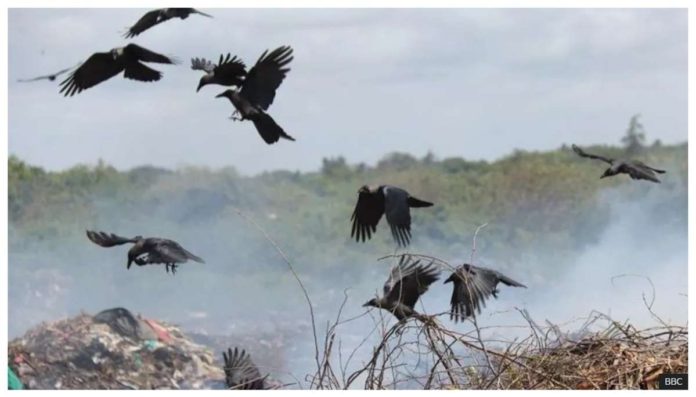
NAIROBI — “Invasive alien birds” sounds like the strapline to a scary Hollywood blockbuster but for the people of coastal Kenya it is not a matter of fiction.
The authorities there are so worried about the nuisance created by Indian house crows that they have begun the process of culling a million of them.
They have not targeted humans, as in the Alfred Hitchock horror film The Birds, but these ones have for decades caused widespread disruption, by preying on wildlife, raiding tourist areas and attacking poultry farms.
Poison is now being used in the towns of Watamu and Malindi to kill the first tranche of the ruthless sub-species.
This ambitious poisoning campaign is aimed at halting the crows’ advance towards the capital, Nairobi.
The birds, known on the coast as “kunguru” or “kurabu”, originated from India and other parts of Asia, often spreading elsewhere by travelling on trading ships.
But they are believed to have been intentionally introduced in East Africa around 1890s in a bid to tackle a mounting waste problem on the Zanzibar archipelago, then a British protectorate. From there, they spread to the mainland and up the coast to Kenya.
They were first recorded in the port of Mombasa in 1947 and since then, their numbers have exploded, thanks to the growing human population and the accompanying mounds of rubbish, which provide an ideal environment for the birds to feed and breed. They also have no natural predators.
The Indian house crows, considered one of the world’s most invasive and destructive birds, have continued their northward journey.
“They prey on the indigenous species, not just birds but also mammals, reptiles – and so their impact on biodiversity is devastating,” Jaap Gijsbertsen, a Dutch bird expert, who is visiting Kenya’s Watamu area, told the BBC.
Conservationists say that the crows have significantly reduced the number of small indigenous birds in the region, such as weavers and waxbills, by ripping their nests apart while targeting eggs and even chicks.
“When the population of local birds declines, the environment begins to suffer. There will be a possible increase of harmful pests and insects that the birds prey on,” Lennox Kirao, a research scientist with conservation group A Rocha Kenya, said.
They also damage crops, livestock and chickens.
“They pounce on chicks and eat them like madmen. These are not normal birds, they act wildly,” said Eunice Katana, a resident of Takaye village in Kilifi county.
They are also known to use a unique sound to communicate distress – or when they spot a prey, according to Kirao.
The birds have defaced houses in Mombasa by defecating on the walls and roofs, while many people shy away from sitting under tree shades for fear of being dirtied by their droppings.
“These crows rise early and interrupt our sleep with their annoying squeals and cawing,” Mombasa resident Victor Kimuli told the BBC.
Given all these issues the authorities felt they had to act and aim to halve the Indian house crow population through poisoning, which began on Tuesday.
This follows months of consultations with environmental experts, conservationists, community leaders and representatives from the hotel industry, the Kenya Wildlife Service (KWS) said.
“We are trying to get their population down to a controllable number,” said Kirao.
The culling process involves months of pre-baiting – where the birds are encouraged, through leaving meat out, to gather at various places near their roost sites.
“We then poison them after pulling together the highest number in the baiting sites,” Eric Kinoti, an official from the A Rocha Kenya, said.
An avian poison called Starlicide is so far the only known substance that has proved effective in reducing crow numbers, without affecting other birds or animals.
Close to 2,000 crows were killed in 2022 during efficacy tests carried out on the poison by Little Kenya Gardens, the company licensed to import the poison, Cecilia Ruto, owner of the firm, said.
“The slow-acting poison is entirely metabolized by the crow before it dies – which means, there is little risk of secondary poisoning to any other species that feeds on the dead crow,” Ruto added.
There are currently 2kg (4.4lb) of the poison in the country which is estimated to be able to kill about 20,000 crows in the ongoing eradication. But there are plans to import more from New Zealand.
Its use in Kenya has, however, raised ethical concerns from animal and bird rights activists, who argue that poisoning the crows is inhumane and that alternative and non-lethal methods should be explored.
“Mass poisoning is a short-term solution that does not address the root cause of the problem,” said Leonard Onyango, an environmentalist.
“There is a need to look at sustainable, humane approaches to manage the crow population,” he added.
But those involved in the programme emphasize the need to protect native species and ensure ecological balance.
“If we do nothing now, the damage could become irreversible,” said Kirao, who is involved in the culling programme.
This is not the first time the government has initiated plans to control invasive bird species.
The previous attempt more than 20 years ago reduced the bird population, but the government later banned the importation of Starlicide in an effort to regulate what was coming into the country. (BBC)