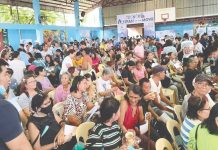


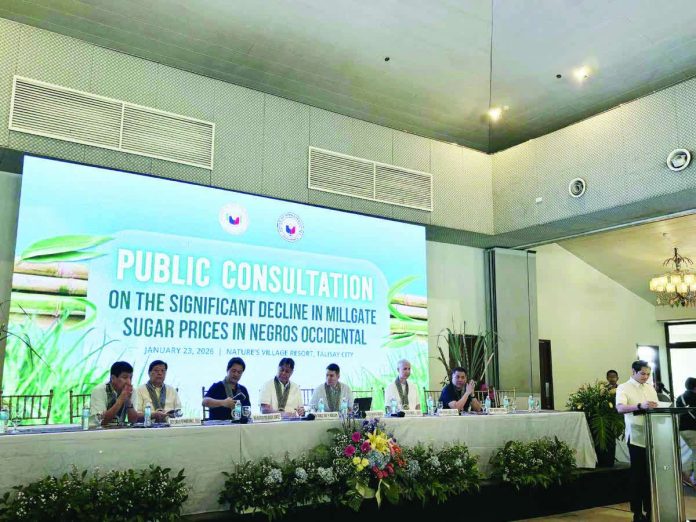
BACOLOD City — Key government officials, sugar industry leaders, producers, and workers convened for a public consultation to address the significant decline in millgate sugar prices in Negros Occidental and its growing impact on farmers, laborers, and rural communities.
Held pursuant to House Resolution No. 373, the consultation served as a platform for stakeholders to present data, share on-the-ground experiences, and identify policy gaps affecting the domestic sugar industry.
Discussions focused on pricing trends, rising production costs, market disruptions, regulatory concerns, and the welfare of sugar workers and small planters.
The consultation was led by Senator Francis Pangilinan, chair of the Senate Committee on Agriculture, Food, and Agrarian Reform, and Congressman Wilfrido Mark Enverga, chair of the House Committee on Agriculture and Food.
The event was held on January 23 at Nature’s Village Resort in Talisay City, Negros Occidental, and was hosted by Negros Occidental Third District Representative Javier Miguel Benitez, the author of House Resolution No. 373.
Also present at the event were Bacolod Lone District Representative Alfredo Abelardo Benitez; Fifth District Representative Dino Yulo; Sixth District Representative Mercedes Alvarez; Abang Lingkod Party-list Representative Manuel Ko; Governor Eugenio Jose Lacson; and several mayors from across the province.
Negros Occidental remains one of the country’s major sugar-producing provinces.
Participants traced the current price decline to a convergence of production, trade, and market pressures ahead of the 2024–2025 milling season.
Benitez said the sugar industry entered the crop year already weakened by adverse weather conditions and biological threats, particularly the red-striped soft scale insect (RSSI), which affected more than 1,500 hectares of sugarcane farms and significantly reduced yields. He added that prolonged dry spells followed by persistent rainfall further compromised cane quality and lowered sugar recovery rates.
To ensure adequate national supply, the government authorized the importation of up to 424,000 metric tons of refined sugar under Sugar Order No. 8 for the 2024–2025 crop year. Although classified as reserve sugar, the arrival of imports from July to November 2025 overlapped with the opening of the domestic milling season in October.
As milling began, millgate prices of locally produced sugar fell sharply. By early October 2025, prices dropped to an average of P2,200 per 50-kilogram bag—nearly P300 below the estimated cost of production and significantly lower than the P2,700 to P2,800 opening prices recorded in the previous crop year.
Sugar industry groups attributed the sudden decline to market uncertainty triggered by the timing and volume of authorized imports.
Stakeholders also noted that conflicting public statements from industry federations contributed to confusion among traders, slowing transactions and further depressing prices at a critical point in the milling season, when farmers traditionally rely on stable prices to recover production costs.
These developments raised serious concerns over the long-term viability of sugarcane farming, particularly for small planters, as prices continued to fall below production costs. Calls for greater transparency, policy review, and sustained dialogue across the sector ultimately led to the convening of the public consultation.
In his statement, Benitez acknowledged the gravity of the situation facing the industry.
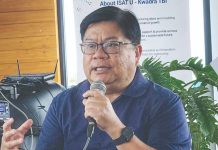
“The sugar industry across the country is once again in a critical state. That is the reality. That is the situation that brings us all here today,” Benitez said. “This is neither new nor isolated. History reminds us that our industry has endured cycles of hardship many times before.”
Enverga said the consultation would help inform the upcoming congressional inquiry in aid of legislation.
“We are already hearing the major concerns initially from the stakeholders, so there will be action coming from Congress,” he said./PN