


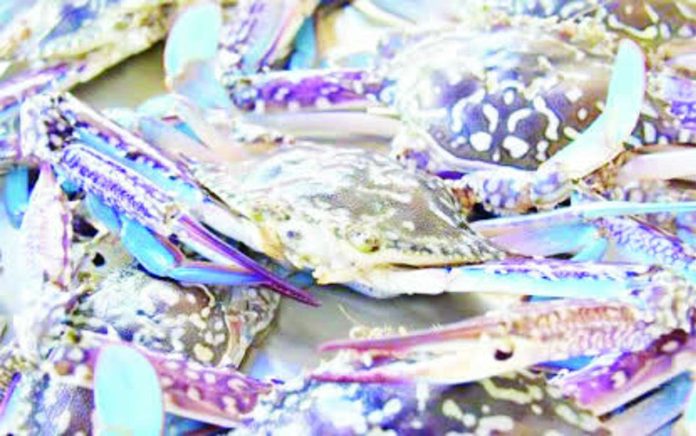
BACOLOD City — The Metro Bacolod Chamber of Commerce and Industry (MBCCI) and officials of the Negros Occidental provincial government are urging immediate reforms in fisheries management and environmental monitoring following the closure of the United States market to Philippine blue swimming crab exports, warning of serious economic consequences for thousands of coastal families and workers.
The MBCCI and the Sangguniang Panlalawigan (SP) of Negros Occidental have separately called on national government agencies to address regulatory gaps that led to the ban while strengthening long-term sustainability measures for one of the country’s most valuable fisheries industries.
The United States officially barred imports of Philippine blue swimming crab products effective June 11 after the country failed to secure a “comparability finding” under the U.S. Marine Mammal Protection Act (MMPA).
The restriction was imposed not because of food safety or product quality concerns but due to insufficient evidence showing that Philippine fisheries maintain marine mammal protection standards comparable to those required in the United States.
According to U.S. regulators, the Philippines lacked adequate documentation, monitoring systems, reporting mechanisms, and conservation measures related to marine mammal bycatch, including incidents involving dolphins, whales, and other protected species.
Provincial Board Member Hope Marey Depasucat, author of a recently approved SP resolution, described the situation as alarming given the country’s heavy dependence on the U.S. market.
“The Philippines now stands as the only major blue swimming crab-exporting nation whose products have been barred from entering the United States,” Depasucat said.
She noted that competing exporters such as Indonesia, Vietnam, and Sri Lanka retained access to the American market after complying with U.S. requirements and submitting the necessary documentation.
The United States accounts for about 90 percent of Philippine blue swimming crab exports. The country traditionally ships more than 2,400 metric tons of crab meat annually to the U.S., generating billions of pesos in export earnings.
Depasucat warned that the market closure threatens the livelihoods of thousands of fishermen, crab meat pickers, processing plant workers, traders, and transport providers who depend on the industry.
Negros Occidental Gov. Eugenio Jose Lacson described the U.S. ban as a significant setback to the province’s economy.
“The loss of the American market creates a substantial gap in earnings for fishermen, traders, processors, and other workers throughout the supply chain,” Lacson said.
The governor appealed to the Bureau of Fisheries and Aquatic Resources (BFAR) to immediately establish and implement protocols that would enable Philippine blue swimming crab products to regain access to the U.S. market.
Provincial officials stressed that swift compliance with international fisheries monitoring and conservation requirements is essential to restoring market confidence and protecting jobs.
Preventing another industry collapse
Beyond the immediate impact of the export ban, the MBCCI is urging government agencies to conduct a comprehensive review of the blue swimming crab sector, warning that Negros Occidental could face a repeat of the collapse that devastated the region’s prawn industry decades ago.
In a position paper submitted to government agencies and local government units, MBCCI Vice President for Government Affairs Frank Carbon said declining crab harvests, environmental degradation, and fragmented management systems pose long-term risks to the industry.
“The prawn industry collapsed because stakeholders acted too late. Today, the blue swimming crab industry stands at a similar crossroads,” Carbon said.
MBCCI cited fisheries studies showing a significant decline in crab harvests in Western Visayas and pointed to growing concerns over habitat degradation, coastal pollution, and post-harvest losses.
The chamber stressed that the industry remains a critical economic driver in Western Visayas, particularly in Negros Occidental, where thousands of families rely on fishing, crab processing, and related enterprises for income.
“Protecting the crab industry is not only an environmental issue. It is a livelihood issue affecting thousands of families across Negros,” Carbon said.
He said the U.S. ban should serve as a wake-up call for the country to strengthen fisheries governance and environmental compliance.
MBCCI identified several challenges hampering industry development, including fragmented implementation of fisheries regulations, the absence of a unified monitoring and reporting system, and the lack of a dedicated coordinating body to align government, industry, and community efforts.
The chamber is advocating the creation of a Unified Negros Blue Crab Development Plan that would integrate fisheries management, environmental protection, livelihood development, and export compliance programs.
Among its recommendations are the adoption of digital traceability systems, improved fisheries monitoring, mangrove rehabilitation, marine litter reduction initiatives, and enhanced data collection mechanisms that meet international sustainability standards.
The group also proposed designating Negros Occidental as a national pilot province for blue swimming crab sustainability initiatives.
Clarifying the reason behind the ban
Community development worker and social activist Joel Jaquinta emphasized the importance of public understanding of the issue, noting that misinformation has circulated regarding the reasons behind the U.S. action.
Citing official findings from the U.S. National Oceanic and Atmospheric Administration (NOAA), Jaquinta clarified that the ban was not imposed because of the catching of juvenile crabs or violations of food safety regulations.
“The issue identified by NOAA relates to monitoring, reporting, documentation, and demonstrating that Philippine fisheries management provides marine mammal protection measures comparable to U.S. standards,” he said.
Jaquinta added that countries such as Indonesia, Vietnam, and Sri Lanka were able to maintain market access after submitting additional information and strengthening compliance measures.
Both business leaders and provincial officials agreed that the challenge requires a coordinated national response involving the BFAR, the Department of Environment and Natural Resources, the Department of the Interior and Local Government, local government units, and private sector stakeholders.
While the export ban poses an immediate economic threat, they believe it also presents an opportunity to modernize fisheries management, improve sustainability practices, and strengthen the industry’s long-term competitiveness in global markets.
For Negros Occidental, where coastal communities depend heavily on the blue swimming crab industry, the stakes are high.
“The crab industry can still recover,” Carbon said. “But government, industry, and communities must work together now to address compliance gaps, protect marine resources, and secure the future of thousands of families who depend on this sector.”/PN