

![“The Pharmally case... there are 46 respondents [in our complaint], kaya medyo matagal. And many of them have become invisible. Para bang they're trying to evade the jurisdiction of this body,” says Ombudsman Jesus Crispin Remulla.](https://www.panaynews.net/wp-content/uploads/2026/10/plunder_copy_resized_resized-218x150.jpg "Ombudsman presses P11-B Pharmally plunder case But 23 respondents missing— Remulla")
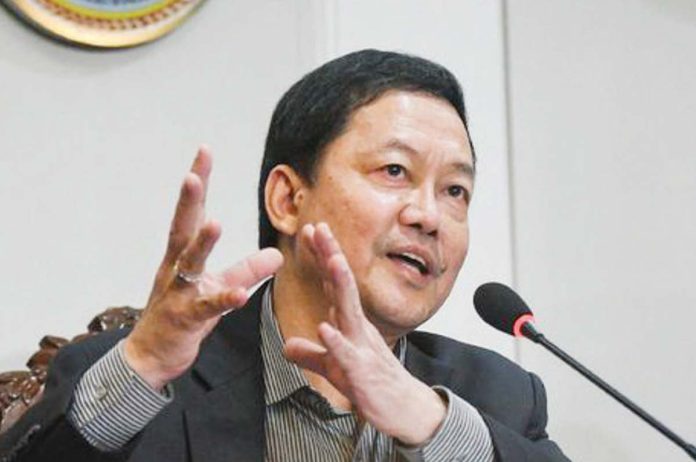
MANILA – The Office of the Solicitor General presented its defense before the Supreme Court on Tuesday regarding the transfer of funds from the Philippine Health Insurance Corp. (PhilHealth) to the national treasury.
Solicitor General Menardo Guevarra said the fund transfer was a “temporary measure” aimed at addressing concerns about the availability of funds for essential government programs and projects within the legal framework of the Philippine government.
“I assure the Honorable Court and the people that, contrary to what has been portrayed by some critics, there was no dark or sinister plan behind the transfer of the P60-billion fund balance from PhilHealth to the treasury,” Guevarra during the SC oral argument.
Additionally, Guevarra requested, as a procedural issue, the removal of President Ferdinand “Bongbong” Marcos Jr.’s name from the list of respondents, referencing legal precedents that affirm the Chief Executive’s immunity from legal action while in office.
In October, the Supreme Court issued a temporary restraining order to halt any further transfers of PhilHealth funds to the national treasury.
The petitions were initiated by the 1Sambayan Coalition, led by Senate Minority Leader Aquilino Pimentel III, along with another group spearheaded by Bayan Muna party-list chair Neri Colmenares, seeking to prevent the transfer of P89.9 billion in excess funds from PhilHealth.
Despite this, P60 billion in unutilized funds had already been transferred, leaving only P29.9 billion with PhilHealth.
Guevarra explained that this decision was made to enable the government to carry out its priority programs without incurring additional debt.
“It might have been less complicated if the national government simply borrowed money. But then, we must consider that, as of the end of February 2024, the national government debt was already recorded at P15.18 trillion,” he explained.
He further noted that, based on a projected population of 114 million in 2025, each Filipino, regardless of age, wealth, or ability, would bear a debt of P139,000.
“This is rather heavy. It is in this cash-starved context that the Congress trained its sight on money that was there but was not being productively utilized,” he said.
Guevarra stated that the executive and legislative branches are employing a strategy to formulate and execute a fiscal policy aimed at stimulating economic growth while avoiding an increase in government debt or imposing new tax burdens on the populace.
He emphasized that this approach is “a common-sense strategy that adheres to all legal standards, including constitutional provisions.”
Guevarra highlighted that state financial officials have assessed that over a span of three years, the total government subsidies allocated to PhilHealth reached P239.11 billion, whereas the total benefit claims from indirect contributors amounted to only P149.23 billion.
Specifically, the government subsidies surpassed the total benefit claims of indirect contributors by P27.12 billion in 2021, P23.97 billion in 2022, and P38.79 billion in 2023, culminating in a total excess of P89.9 billion.
“PhilHealth’s fund balance of P89.9 billion was thus an accumulation of three years’ worth of government subsidies which had remained unexpended or unutilized as of the end of 2023,” Guevarra said./PN