



BY GEROME DALIPE
ILOILO City – The national government needs to generate a whooping investment of P72 billion to reach 100 percent of electrification in the country, an official of the Department of Energy (DOE) said yesterday.
During the seminar here facilitated by the US Embassy, Undersecretary Rowena Cristina Guevara said the DOE’s National Total Electrification Roadmap for 2023 to 2032 estimated the total cost of electrification stands at P72 billion, or about P26,618 per household.
In return, Guevara said the government will generate a net economic benefit of P315 billion, representing about 1.8 percent of the gross domestic product.
Using electrification its collected data and the Philippine Statistics Authority (PSA), the agency pegged the access to electricity for up to eight hours per day, which resulted in an increase of 15.8 percent in income and 14.8 percent in expenditures.
Guevara noted that increasing access to electricity from eight hours to up to 16 hours per day results in an increase of 33.4 percent in income and 32.7 percent in expenditures.
“Increasing access to electricity from 16 hours per day to an uninterrupted service of 24 hours per day results in an increase of 56.3 percent in income and 59.4 percent in expenditures,” said Guevara.
The U.S. Embassy in Manila is holding a two-day seminar dubbed “Powering Progress: The Path Toward the Philippines’ Clean Energy Transition” at the Courtyard by Marriott Hotel Iloilo.
Journalists from all over the country attend the two-day seminar to learn about the Philippines’ effort to transition to a carbonless energy society.
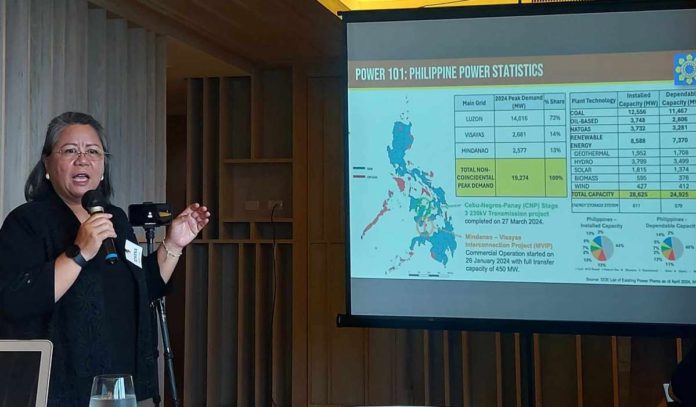
In her presentation, Guevara said the country is highly vulnerable to the impacts of climate change. The high heat index in April and May resulted in red and yellow alerts.
“Renewable energy (RE) is crucial for the Philippines in addressing the challenges of climate change and economic development, among others,” she noted.
As an archipelago vulnerable to climate-related disasters, Guevara said the country needs to mitigate greenhouse gas emissions. Transitioning to renewable energy sources like solar, wind, and geothermal can reduce dependency.
“With energy demand in the Philippines projected to increase by 6.6 percent annually until 2040, investing in renewable energy infrastructure can diversify the country’s energy mix, reduce dependence on imported fuels, and enhance energy security,” she said.
The energy department is targeting a transition from traditional fossil fuel to carbonless by 35 percent of renewable energy in 2030.
Since the passage of the law on renewable energy in 2008, Guevarra said that access to financing remains a “massive problem.”
Citing the National Renewable Energy Program 2020 – 2040, Guevarra noted that only 17 percent of renewable energy service contracts from 2009 to 2019 were completed, signifying the challenges faced by the energy sector.
These include delays in policy implementation, complex permitting, grid interconnection issues, resource development hurdles, limited financing access, and climate change risks.
“Despite these challenges, the government is committed to pursuing a future energy scenario that is clean, around which we have formulated and implemented policies and various mechanisms,” said Guevara.
The Philippines is leveraging renewable energy to align with the global energy transition.
Ranked 60th in the 2022 Energy Trilemma Index, the country saw a 27 percent increase in renewable projects and a 68 percent increase in potential capacity by 2023.
“The country excels in energy security, improving environmental sustainability scores, but lags in energy equity. Efforts continue to enhance renewable energy generation while reducing carbon emission and improving energy intensity,” said Guevara.
The country’s energy sector is estimated at P630 billion peso industry. There are about 226 generation companies with 593 power plants, one transmission concessionaire, 484 WESM participants, 141 distribution utilities, 143 Retail Electricity Suppliers, and one Energy Regulatory Commission.
An estimated P7.6-trillion investment requirement is needed to achieve the DOE’s Philippine Energy Plan 2020 – 2040 to reach 92.3 GW by 2040.
“Our energy sector faces numerous challenges and opportunities, and it is vital for the public to receive a well-rounded understanding of the issues,” Guevara said.
“The DOE is committed to transparency, accountability, and continuous improvement in our services to the Filipino people. We strive to address concerns, implement effective solutions, and collaborate with various stakeholders, including media, to achieve our goals,” she added./PN