



MANILA – Malacañang rejected claims that the P6.97-trillion national budget for 2026 contains pork barrel allocations, maintaining that safeguards in the law prevent lawmakers from exerting control over spending.
Executive Secretary Ralph Recto said the Marcos administration is confident that the General Appropriations Act (GAA) for 2026 complies with constitutional limits, stressing that legislators have no role in budget execution once the measure is enacted.
“Ang tingin namin pork barrel-free. Hindi naman puwedeng makialam ang legislators pagdating sa execution ng budget. Purely executive function na ’yan,” Recto said.
Recto said the executive branch would strictly follow provisions in the GAA, including restrictions that bar elected officials from participating in the distribution of government financial assistance programs, commonly referred to as ayuda.
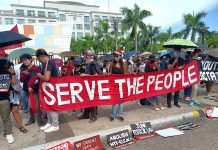
The Palace’s remarks come amid criticism from several lawmakers and civil society groups who alleged that discretionary funds — dubbed “grilled pork” — were embedded in various budget items.
Some critics also argued that the spending plan fell short in supporting agrarian reform and national industrial development.
Members of the progressive Makabayan bloc claimed that the 2026 budget contains several forms of pork barrel, including what they described as “presidential pork,” “vice-presidential pork,” “allocables,” “hard pork,” “soft pork,” “generals’ pork,” and a newer version they referred to as “LGU pork.”
They pointed to increases in lump-sum allocations, noting that the Local Government Support Fund rose by P41.87 billion, from P16 billion under the National Expenditure Program to P57.87 billion in the bicameral conference committee-approved version.
Financial assistance to local government units also expanded sharply from P5 billion to P37.5 billion, while the Growth Equity Fund increased from P1 billion to P11.3 billion.
Critics further alleged that some lawmakers, particularly those from political dynasties, treat LGUs as “parking areas” for pork barrel funds, especially in areas under the control of family members.
In response, Recto cited existing legal constraints, including a 2013 Supreme Court ruling that declared pork barrel unconstitutional for violating budgetary principles by allowing legislators discretion over public funds.
President Ferdinand “Bongbong” Marcos Jr., when he signed the 2026 GAA into law, reiterated that the government would enforce provisions prohibiting politicians from directly distributing financial aid.
“Kung ’di ako nagkakamali, may special provision o general provision sa budget na bawal ang mga politiko sa actual disbursement o pamimigay nito sa mga kababayan natin. Susundan natin ’yung guidelines na ’yan under the GAA of 2026,” Recto said.
The enrolled budget law reportedly includes an “anti-epal” provision aimed at preventing politicians from using government-funded programs and projects for personal promotion.
Section 19 of the General Appropriations Bill states that all cash assistance and similar financial aid must be released solely by authorized government personnel or accredited partners.
It explicitly prohibits elective officials, candidates, political parties, and their representatives — unless they have direct administrative authority — from influencing, attending, or participating in the actual distribution of aid./PN