



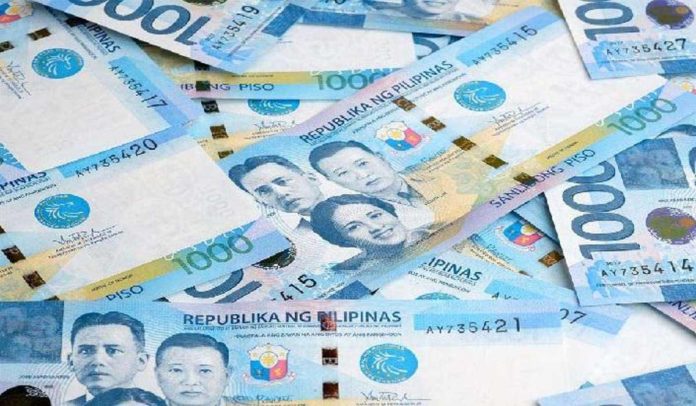
THE Philippine peso hit a 19-month low for the third consecutive trading day on Wednesday, June 5, following the release of local economic data that showed consumer prices grew at six-month high pace in May.
The local unit lost 7 centavos to close at P58.78:$1 from Tuesday’s finish of P58.71:$1. This is the worst showing since November 3, 2022’s finish of P58.80:$1.
The depreciation comes after the Philippine Statistics Authority (PSA) reported May inflation at 3.9%, reflecting an acceleration from the previous month’s 3.8%, and the fastest since November 2023’s 4.1%.
“The US dollar/peso exchange rate went up for the third consecutive trading day… after the latest pickup in headline inflation to 3.9%, the fastest in six months or since November 2023, but slightly slower versus market expectations,” Rizal Commercial Banking Corp. (RCBC) chief economist Michael Ricafort said in a mobile message.
Ricafort also cited less dovish signals from local monetary authorities, after Bangko Sentral ng Pilipinas (BSP) governor Eli Remolona Jr. on Tuesday said it would be “too aggressive” to cut monetary policy by 150 basis points in two years, given the present trajectory of growth.
Finance Secretary Ralph Recto earlier said the BSP could cut rates by 150 basis points in the next two years, with inflation expected to slow down moving forward.
Asked if the peso could again hit its record-low of P59:$1 recorded in October 2022, another economist said the country’s macroeconomic fundamentals show that the country is in a better position to support the local currency this time around.
“So far the BSP hasn’t been intervening as much as before… I do have to say, the fundamentals today as compared to 2022, is much, much better,” The HongKong and Shanghai Banking Corp. Ltd. (HSBC) ASEAN economist Aris Dacanay said at a separate briefing in Taguig City.
Dacanay cited the current account deficit, the elevated inflation, and hike rates by the Federal Reserve in 2022, factors which he said are no longer present.
“Those things aren’t happening today, so I do think that even without the BSP intervention… it’s much better for it to support the peso and to basically not reach that (P59:$1 level), hopefully,” he said.
According to Remolona, the central bank intervenes in the foreign exchange market when it is “under stress” or when it finds some “dysfunction in the market.”
BSP senior assistant governor Iluminada Sicat last week said the recent weakness of the peso is only temporary, as the greenback is buoyed by developments overseas.
The local equities, meanwhile, was not as affected by the May inflation data as the local stock barometer PSEi gained 54.90 points or 0.86% to 6,441.32 while the broader All Shares index climbed 14.65 points or 0.43% to 3,453.69. (GMA Integrated News)