



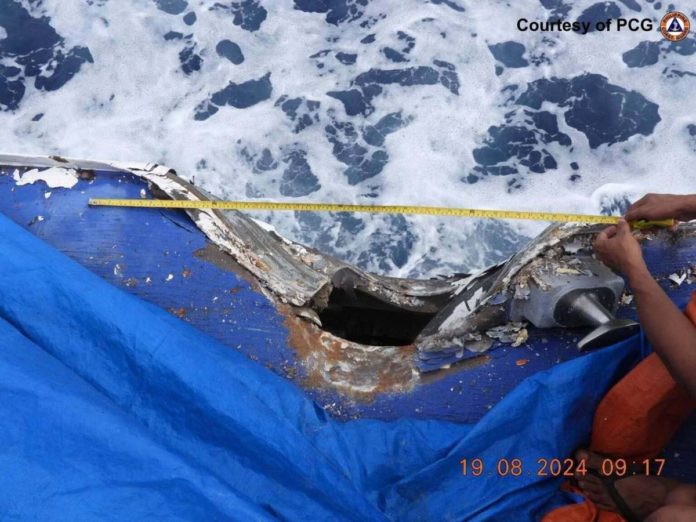
MANILA – The Philippines accused the Chinese Coast Guard of performing “unlawful and aggressive maneuvers” that resulted in collisions of the two country’s vessels near Escoda Shoal in the West Philippine Sea (WPS) early Monday.
The National Task Force for the West Philippines Sea (NTF-WPS) said Philippine Coast Guard (PCG) vessels BRP Bagacay and BRP Cape Engaño were en route to WPS’ Patag and Lawak islands when they encountered CCG’s maneuvers.
“This morning, the Philippine Coast Guard (PCG) vessels BRP Bagacay (MRRV-4410) and BRP Cape Engaño (MRRV-4411) encountered unlawful and aggressive maneuvers from Chinese Coast Guard vessels while en route to Patag and Lawak Islands in the West Philippine Sea,” NTF-WPS said
“These dangerous maneuvers resulted in collisions, causing structural damage to both PCG vessels,” their statement added.
CCG spokesperson Gan Yu has earlier claimed that Philippine vessels BRP Bagacay and BRP Cape Engaño “deliberately” collided with a CCG vessel near Escoda Shoal.
“At 03:24, the Philippine ship No. 4410 (BRP Bagacay) ignored China’s repeated solemn warnings and deliberately collided with China’s 21551 boat, which was normally safeguarding its rights and enforcing the law in an unprofessional and dangerous manner, resulting in a collision,” Gan said.
Gan added that the CCG also took “control measures” against the Philippine vessels for the supposed deliberate collision.
“The responsibility lies entirely with the Philippines. We warn the Philippines to immediately stop its infringement and provocation, otherwise all the consequences arising therefrom will be borne by the Philippines,” Gan said.
Escoda or Sabina Shoal is located 75 nautical miles or about 140 kilometers off Palawan and is within the Philippines’ 200-nautical-mile exclusive economic zone (EEZ).
Despite talks for deescalation, tensions continue amid China’s massive claim in the South China Sea, including the portion the Philippines refers to as the WPS.
The SCS is a conduit for more than $3 trillion in annual ship commerce. Aside from the Philippines, China has overlapping claims in the area with Vietnam, Malaysia, Indonesia, and Brunei.
In 2016, an international arbitration tribunal in The Hague ruled in favor of the Philippines over China’s claims in the SCS, saying that it had “no legal basis,” but China does not recognize the decision./PN