



FOR YEARS, the Philippines has struggled with a persistent drain of skilled workers, weakening the economy’s ability to compete with its regional peers.
The government has taken steps to persuade talented Filipinos to stay, while companies have offered higher salaries and other incentives to retain top performers. Yet those efforts have done little to stem the flow of highly skilled workers leaving the country for better opportunities abroad.
Now, the rise of artificial intelligence (AI) is forcing companies to confront a new question: where should they put their money—in technology that can automate work, or in the people whose skills have long been essential to their growth?
A new study by Aon plc, a global professional services firm, offers a glimpse of how companies are navigating that tension, with Philippine employers planning to raise salaries even as businesses weigh how AI could reshape their workforces.
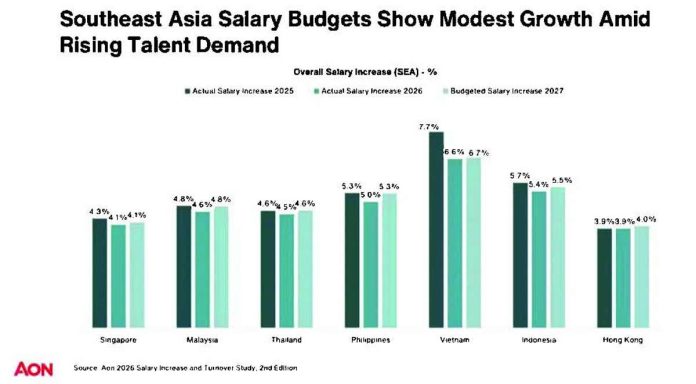
In its 2026 Salary Increase and Turnover Study for Southeast Asia, which covered more than 1,200 organizations across more than 20 industries, Aon says Philippine companies have budgeted an average salary increase of 5.3 percent for 2027.
That will be slightly higher than the 5-percent increase that companies actually gave workers this year. Philippine employers also delivered a 5.3-percent pay increase in 2025, according to Aon.
Companies in consulting, business and community services are planning the biggest increases next year, with salaries expected to rise 6.7 percent, up from 4.8 percent in 2026.
They are followed by life sciences and medical services, where pay is projected to increase 5.8 percent, down from 6.2 percent this year.
Technology companies have budgeted a 5.2-percent increase for 2027, up from 4.8 percent this year. Manufacturing employers are planning a 4.9-percent increase, slightly below this year’s 5-percent adjustment.
In financial services, salaries are projected to rise 4.2 percent, compared with 4 percent this year.
“Boardrooms face important decisions on how to allocate investment in technology and talent while navigating an uncertain environment fraught with emerging and interconnected risks,” Rahul Chawla, Aon’s head of talent solutions for Southeast Asia, says in the report.
“Persistent inflation and ongoing skill shortages are directing investments toward the roles and skills that will drive returns on their broader business investments,” he says.
Employee turnover remained in double digits across all of the Southeast Asian markets covered by Aon in 2026.
Malaysia had the highest rate at 17.4 percent, followed by the Philippines at 17.3 percent and Singapore at 16.8 percent.
In the Philippines, 38 percent of the companies surveyed had planned to expand their workforces, while 39 percent expected to scale back hiring.
The split reflects an uncertain business environment: 40 percent of companies had a positive outlook, while 35 percent anticipated more challenging conditions.
The findings suggest that pay is only one part of the equation for companies competing for scarce talent. Aon says employers also need to consider career development, opportunities for advancement and a broader sense of purpose if they want to attract and retain workers over the long term.
As AI accelerates changes across industries, companies are also looking for better ways to understand where their talent investments are most needed. (Ian Nicolas P. Cigaral © Philippine Daily Inquirer)