
[av_one_full first min_height=” vertical_alignment=” space=” custom_margin=” margin=’0px’ padding=’0px’ border=” border_color=” radius=’0px’ background_color=” src=” background_position=’top left’ background_repeat=’no-repeat’ animation=”]
[av_heading heading=’Police, soldiers in ‘battle mode’’ tag=’h3′ style=’blockquote modern-quote’ size=” subheading_active=’subheading_below’ subheading_size=’15’ padding=’10’ color=” custom_font=”][/av_heading]
[av_textblock size=” font_color=’custom’ color=’#0a0a0a’]
Monday, February 6, 2017
[/av_textblock]
[av_image src=’http://www.panaynews.net/wp-content/uploads/2017/02/negros-troops-495×374.jpg’ attachment=’95597′ attachment_size=’portfolio’ align=’center’ styling=” hover=” link=” target=” caption=’yes’ font_size=’14’ appearance=’on-hover’ overlay_opacity=’0.4′ overlay_color=’#000000′ overlay_text_color=’#ffffff’ animation=’no-animation’]
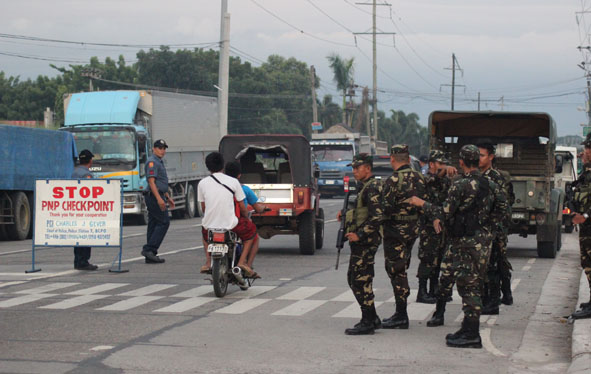
In this September 2016 photo, police officers and Philippine Army troops work together at a checkpoint in Bacolod City. Police and soldiers are coordinating on the deployment of forces after the government and the communist rebels lifted their respective unilateral ceasefires. PN FILE
[/av_image]
[av_textblock size=” font_color=’custom’ color=’#0a0a0a’]
BACOLOD City – Police officers and soldiers in Negros Island Region were ready to engage when necessary after the New People’s Army (NPA) withdrew its five-month unilateral ceasefire with the government.
“The August 28 unilateral ceasefire shall effectively expire on 11:59 p.m. of Feb. 10,” the NPA announced on Feb. 1.
In response, Senior Superintendent Mariano Natu-el Jr., deputy director for operations of the Police Regional Office 18 (PRO-18), said he led the accounting of regional police personnel starting Friday, Feb. 3.
Police officers across the island region were in “battle mode”; all stations were ordered to remain vigilant, Natu-el said.
The PRO-18 was also working with the Philippine Army for the augmentation and deployment of troops, he added.
In ending the truce, the NPA cited two reasons: the Duterte administration’s failure to release 200 political prisoners and the alleged military advances in NPA-held areas.
“Unfortunate” was how the Philippine National Police described the termination of the unilateral ceasefire.
After the NPA’s announcement, spokesperson Senior Superintendent Dionardo Carlos said the police will “continue to observe the suspension of offensive police operations to honor the Philippine government’s own declaration of a unilateral ceasefire with” the rebels.
But President Rodrigo Duterte ordered Gen. Eduardo Año, the Armed Forces chief, to terminate the ceasefire on Friday evening.
“We cannot have a peaceful generation. There will always be a fight,” he said in a speech in North Cotabato. “But let it not be said that I did not try. So I guess that peace with the communists cannot be realized during our generation. Maybe years from now.”
Meanwhile Brigadier General Francisco Delfin, commander of the Philippine Army’s 303rd Infantry Brigade based in Murcia, Negros Occidental, said the troops were directed to reinforce detachments and police stations, especially in “vulnerable areas.”
Soldiers will conduct security patrols in “critical areas” and were authorized to engage if they encounter rebels, Delfin said.
Colonel Edgard Arevalo, chief of the Armed Forces’ Public Affairs Office, said they will continue protecting communities from extortion, burning of vehicles, farm and livelihood implements, and other forms of criminal acts, whoever the perpetrator is.
“We will continue to perform peace-building and development efforts where the people in conflict areas request us to,” he said. “We will continue to capacitate local government to deliver basic goods and services to their constituents.” (With reports from Philippine News Agency/PN)
[/av_textblock]
[/av_one_full]