


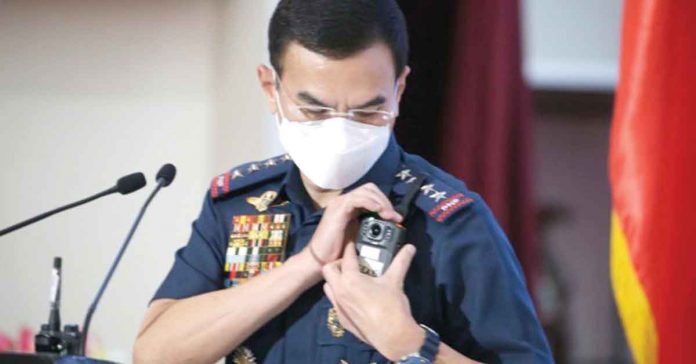
ILOILO City – The Police Regional Office 6 (PRO-6) is still waiting for the guidelines from the national office on the use of 256 body cameras issued to various police units in Western Visayas for various operations.
According to PRO-6 spokesperson, Police Lieutenant Colonel Joem Malong, training is required prior to using these cameras. The training would include reconfiguration, technical requirement and proper equipment handling.
Every police station must also have a command center that would monitor the movement of the user via a Global Positioning Satellite System installed on the body cameras.
“As of now, we are in the process of reconfiguration,” Malong said. “Once ma-reconfigure and ma-establish na ang command center we have to conduct demonstration and training on camera handling, the recording process, data repair, and management.”
Malong said only those who underwent training would be allowed to use the body cameras.
So far, 192 body camera units were delivered to 12 police stations under the Negros Occidental Police Provincial Office (NOCPPO), 32 to Iloilo, and 16 each to the Roxas City police station and Bacolod City Police Office.
Here are the police stations that received the body cameras:
NEGROS
* Bago City police station
* Cadiz City police station
* Escalante City police station
* Himamaylan City police station
* Kabankalan City police station
* La Carlota City police station
* Sagay City police station
* San Carlos City police station
* Silay City police station
* Sipalay City police Station
* Talisay City Police Station
* Victorias City Police Station
* Bacolod City Police Office
ILOILO
* Iloilo City Police Office (ICPO)
* Passi City police station
CAPIZ
* Roxas City police station
Meanwhile, the ICPO already distributed two units each to its six police stations and one each for the offices of the Mobile Patrol Unit, Iloilo City Traffic, Iloilo City Police Mobile Force, and City Intelligence Unit.
Philippine National Police Chief, General Guillermo Lorenzo Eleazar, said he would initially want these body cams used by policemen in the service of court-issued search warrants to clear up allegations of irregularities in such operations.
This will serve as protection for both parties, the police operatives and the persons who are subjects of the warrant, Eleazar stressed.
“These body cameras will ensure transparency in police operations and, hopefully, put a stop to allegations that policemen are engaged in planting of evidence or even the summary execution of suspects,” Eleazar said.
Recently, the Supreme Court has ordered law enforcement operatives to wear body cameras during the arrests. Should the device malfunction the arrest would still be considered valid.
This is part of the court’s rules in the use of body-worn cameras in the execution of warrants in a resolution dated June 28.
“Failure to observe the requirement on using body-worn cameras or alternative recording device shall not render the arrest unlawful or render the evidence obtained inadmissible. Facts surrounding the arrest may be proved by the testimonies of the arresting officers, the person arrested, and other witnesses to the arrest,” according to Section 5, Rule 2 on arrest warrants.
A similar rule applies in the implementation of search warrants, but is stricter on law enforcement. Search warrants require a higher standard since they are at the start of case buildups, while arrest warrants are issued after a judge decides that there is sufficient probable cause against the respondent in a complaint.
Under Section 7, Rule 3 on search warrants, failure to observe the requirement of using body-worn cameras or alternative recording device, without reasonable grounds, during the execution of the search warrant shall render the evidence obtained inadmissible for the prosecution of the offense for which the search warrant was applied./PN