



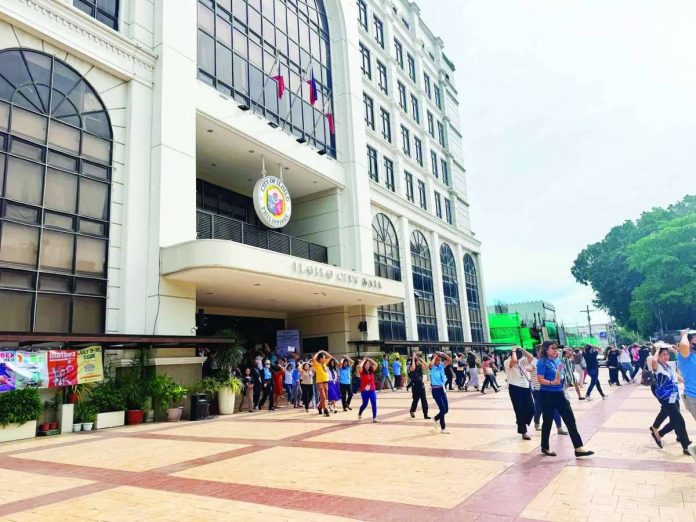
ILOILO City — Iloilo City Hall cut its earthquake drill evacuation time by more than two minutes this year, but disaster management officials warned that employee complacency and failure to follow basic safety procedures remain major vulnerabilities that could cost lives during a real earthquake.
During the National Simultaneous Earthquake Drill (NSED) on Thursday, June 18, the Iloilo City Hall complex was evacuated in five minutes and 58 seconds, a marked improvement from the more than eight minutes recorded during last year’s exercise.
However, evaluators found that many employees either rushed out prematurely without observing the “duck, cover, and hold” protocol or moved too casually despite an active evacuation order.
The observations prompted city disaster officials to stress that improving evacuation time alone is not enough if workers fail to respond properly during an actual seismic emergency.
Darwin Joemil Papa, chief of the Emergency Response Division of the Iloilo City Disaster Risk Reduction and Management Office (CDRRMO), acknowledged the improvement but said the city has yet to reach its target.
“There was a significant improvement compared to last year. We were able to bring down the evacuation time from more than eight minutes to five minutes and 58 seconds,” Papa said.
However, he noted that the result still fell short of the four-minute target identified in the CDRRMO’s time-and-motion study.
“The target based on our study is around four minutes, but congestion along stairways and evacuation routes slowed down the movement of employees. Considering the number of people evacuating simultaneously, bottlenecks are expected,” he explained.
Papa said one of the most concerning observations was that some employees immediately evacuated upon hearing the alarm instead of first protecting themselves.
“Some employees started evacuating even before the siren had finished sounding. In an actual earthquake, that could be dangerous because falling debris, broken glass, and other hazards may still be present while the shaking is ongoing,” Papa said.
Atty. Ricardo Escanlar, co-coordinator of the Iloilo City Hall Earthquake Management Plan, said evaluators identified opposite but equally troubling reactions among employees.
“Although all employees had been briefed beforehand that the siren indicates an earthquake scenario, some immediately rushed downstairs the moment they heard the alarm,” Escanlar said.
“At the same time, there were also employees on the opposite end of the spectrum. Even after the evacuation order had already been given, they descended the stairways too casually and without enough urgency,” he added.
Escanlar also pointed out that several employees neglected to protect their heads while evacuating.
“Several employees did not protect their heads while moving toward the designated safe zones. During an actual earthquake, protecting the head is critical because injuries are often caused by falling objects and debris,” he said.
According to Escanlar, the drill exposed a broader challenge in promoting disaster preparedness.
“Unfortunately, this is one of the problems we need to addressv— not only in City Hall but among Filipinos in general. Earthquake awareness and preparedness remain a challenge because many people do not fully appreciate the risks unless they have personally experienced a major earthquake,” he said./PN