



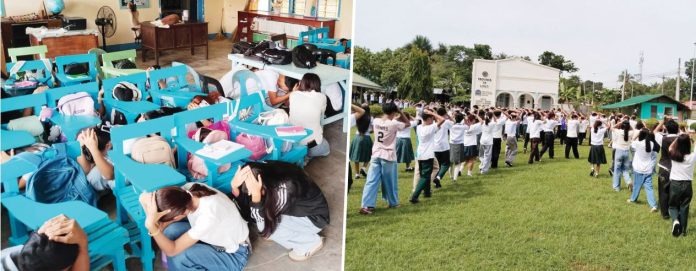
ILOILO City – Nearly 342,000 students in Iloilo may be familiar with earthquake evacuation procedures, but many schools remain vulnerable to major seismic events due to inadequate evacuation spaces, limited rescue equipment, and insufficient emergency response capacity, according to the Schools Division of Iloilo (SDO-Iloilo).
The concern surfaced as all schools under SDO-Iloilo simultaneously conducted the Department of Education’s (DepEd) required earthquake drill on Jun e 18, revealing that while awareness of emergency protocols is high, significant infrastructure and resource deficiencies continue to hamper full disaster preparedness.
Leonil Salvilla, spokesperson of SDO-Iloilo, said all schools successfully participated in the drill but stressed that preparedness must go beyond routine exercises.
Reports submitted to SDO-Iloilo showed that several schools continue to struggle with limited evacuation areas, a problem that could become critical during a strong earthquake.
Salvilla acknowledged that despite years of conducting earthquake drills, schools have yet to overcome several logistical challenges.
“Schools also lack equipment nga pwede magamit for rescue or evacuation. Gina-try naton ini nga i-address. Sa aton Division office may emergency kits mga personnel. We are trying to replicate this sa school level para ma-ensure ang safety and security ka personnel and learners in case may earthquake,” Salvilla said.
The division currently serves 341,896 students, a figure expected to increase as enrollment processing continues, underscoring the urgency of strengthening school emergency preparedness measures.
Salvilla said schools remain dependent on local government units, particularly municipal disaster risk reduction and management offices, for advanced rescue and retrieval operations.
Early this week, DepEd Region 6 urged schools to organize and activate their Disaster Risk Reduction and Management (DRRM) teams, conduct reorientation sessions on “Duck, Cover, and Hold” procedures and evacuation protocols, hold pre- and post-activity briefings, intensify information and education campaigns, and ensure the availability of safe evacuation routes and assembly areas.
The regional office’s appeal comes in the wake of the magnitude 7.8 earthquake that hit the Mindanao region on June 8 during the opening of classes, resulting in the deaths of 61 people.
Panay Island, where Iloilo Province is located, is vulnerable to major earthquakes due to active fault systems in Western Visayas – the West Panay Fault and the Negros Trench.
The West Panay Fault is a 90-kilometer fracture cutting across Panay, specifically running through some of Iloilo Province’s most populated and fast-developing municipalities — San Joaquin, Miag-ao, Igbaras, Tubungan, Leon, Alimodian, Janiuay, and Lambunao — extending northward toward Tapaz in Capiz and Libacao in Aklan.
The West Panay Fault caused the magnitude 7.8 earthquake that struck Panay in January 25, 1948. Widely known as the “Lady Caycay” quake, it killed at least 21 people and destroyed 55 churches — 17 of which collapsed completely. In Iloilo alone, belfries and stone churches in Jaro, San Joaquin, and Arevalo fell in ruins. The ground cracked open and waves surged along the Iloilo Strait.
The Negros Trench, on the other hand, an active subduction zone west of Panay Island. According to the Philippine Institute of Volcanology and Seismology, this trench is capable of generating earthquakes up to magnitude 8.2. Coastal communities in Panay and Negros are at risk of tsunamis, with waves potentially reaching up to three stories high and striking as quickly as 15 minutes after the initial shock./PN