



ILOILO — A growing number of couples in Western Visayas are choosing to stop having children, driving the region’s fertility rate below the population replacement level and signaling a major shift away from the traditional Filipino preference for large families.
Data from the Philippine Statistics Authority’s (PSA) 2025 National Demographic and Health Survey (NDHS) showed that 53.1 percent of currently married women aged 15 to 49 no longer intend to have more children.
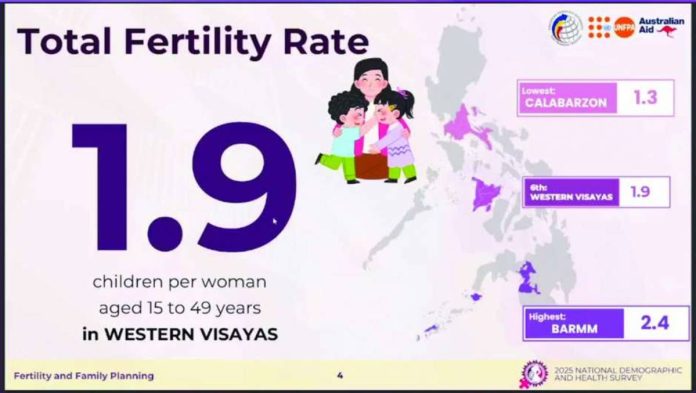
The trend coincided with the continued decline in the region’s Total Fertility Rate (TFR), which fell to 1.9 children per woman in 2025 — below the 2.1 replacement level needed for a population to sustain itself from one generation to the next.
The figure was also lower than the 2.0 recorded in 2022 and far below the 4.2 children per woman logged in 1993.
“In terms of trends, fertility has decreased since 1993, when the total fertility rate was 4.2 per woman. It was only in 2013 when the TFR in the region saw an increase in 3.8 children per woman. In 2025, Filipino women in Western Visayas have an average of 1.9 children per woman,” said Marlene Alviar, chief statistical specialist of the PSA Regional Statistical Services Office 6 (PSA RSSO 6).

Demographers consider the replacement level crucial because it represents the average number of children needed to maintain a stable population, accounting for mortality rates and women who remain childless.
The PSA said the TFR measures the average number of children a woman is expected to bear during her reproductive years if prevailing fertility patterns remain unchanged.
“The 2025 NDHS gathered information on the number of sons and daughters born to women over their lifetime. It also recorded each child sex, date of birth, survival status, and applicable age at death. So, this data was used to calculate the total fertility rate or TFR. This measures the average number of children a woman would have by the end of her childbearing years, if she were to bear children at the current age specific fertility rates,” Alviar stressed.
Despite the decline, Western Visayas still posted a fertility rate higher than the national average of 1.7 children per woman.
“The total fertility rate in Western Visayas is 1.9 children per woman for the three years preceding the survey. If fertility were to remain constant at current levels, a woman would have an average of 1.9 children in her lifetime. This is higher than the national figure of 1.7. Ranking 6th among regions and is still below the replacement level of 2.1 children,” she added.
ECONOMIC PRESSURES
The survey further revealed that economic realities and changing priorities are reshaping family planning decisions across the region.
Among married women who still want children, 12 percent said they intend to have another child within two years, while 17.8 percent preferred to delay childbirth for at least two years. Less than one percent remained uncertain about timing, while 7.1 percent were undecided about having more children altogether.
The preference for smaller families was also reflected across different household categories.
For women without children, the percentage who no longer wanted children rose to 10.9 percent in 2025 from less than 0.05 percent in 2022.
Among women with two children, 66.1 percent no longer wanted additional children, compared to 70.4 percent in 2022.
Among women with three children, 81.9 percent said they no longer wanted more children, down from 86 percent in 2022.
Commission on Population and Development (CPD) Region 6 director Harold Alfred Marshall said financial pressures may be contributing to the decline in fertility.
He noted that many couples increasingly associate childbearing with economic hardship and rising living costs.
The report also showed wider use of family planning methods.
In 2025, 38 percent of women aged 15 to 49 used contraception, with 27.2 percent using modern methods.
The pill remained the most commonly used contraceptive at 13.9 percent, followed by injectables at 3.8 percent and female sterilization at 3.3 percent.
Among currently married women, contraceptive use climbed to 61.9 percent, while the use of traditional methods declined from 19.8 percent in 2022 to 17 percent in 2025.
Population experts warned that the continued drop in fertility rates could eventually affect workforce growth, school enrollment, healthcare planning, and long-term economic productivity in Western Visayas.
They urged policymakers and local governments to closely monitor the demographic shift and prepare for its long-term social and economic consequences./PN