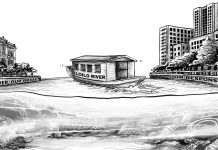




A City I Once Knew
I was bewildered when I read the news. The joint military initiative of the United States and Israel had bombed Iran, specifically Tehran. In retaliation, missiles were launched toward the UAE, KSA, Qatar, Bahrain, Kuwait. Tehran did not sound like a headline to me. Even after two decades, it remains one of those core memories that hasn’t faded at the edges, still sharp and luminous, as if time decided to leave that one untouched.
In March 2002, when I was in high school, my dad, then a corporate executive, brought my mother and me to Tehran for a business trip. The city imprinted itself on me. I remember walking along Keshavarz Boulevard. It was less a commercial strip and more a living corridor of trees and conversations. Restaurants breathed out the aroma of kabab. The Moghadam Museum House felt intimate and precise, almost reverent toward history. My mum and I took the telecabin and saw Mount Tochal crowned with snow. I remember the cold air against my face. I remember feeling small and grateful.
Now I read that Keshavarz Boulevard has been targeted. A civilization that has stretched across millennia finds itself reduced to footage and smoke. I struggle to reconcile the boulevard I walked with the battlefield described. War may have its casus belli. But the consequences rarely stop at the blast site.
They travel quietly. They arrive in HR offices.
Labor Security in the Line of Fire
The first tremor is external. The Philippines has approximately 30,000 Filipinos in Israel and thousands more in high-risk zones. The Philippine News Agency reports that Israel remains under Alert Level 3, which means voluntary repatriation. That phrase sounds procedural. It is not.
Voluntary repatriation forces workers into a brutal calculus. Stay and risk your life. Leave and risk your livelihood. Many stay because poverty feels more certain than rockets. HR practitioners in recruitment agencies and in the Department of Migrant Workers must now counsel families who weigh fear against remittances.
The government has activated a National Reintegration Network, offering up to ₱150,000 in aid and retraining support. On paper, that looks like intervention. In practice, HR must absorb returning workers into a domestic labor market that may not be ready. Reintegration is not only financial but also psychological. A returning OFW does not just bring luggage. They bring trauma, unfinished contracts and their families.
When a worker is repatriated because of war, the journey home is not a simple return. It is an unraveling. An OFW who boards a government-chartered flight (hoping this service will be readily available if worst comes to worst) from a conflict zone such as Tel Aviv does not leave the sirens behind on the runway. They carry them inward. Hypervigilance becomes a habit. Loud noises feel personal. Sleep becomes shallow. There is also a quieter grief such as the loss of routine, of income, of a version of oneself that felt competent and needed abroad. Back home, relatives may say, “At least you’re safe,” not realizing that safety can feel like failure when loans are unpaid and children’s tuition looms.
This is where HR must step in not merely as an administrative unit but as a stabilizing presence. Reintegration programs should include trauma-informed debriefings, access to mental health professionals, peer support circles with fellow returnees and structured career transition planning that restores agency. Skills mapping and fast-tracked local placement can reduce the identity shock of sudden unemployment. Even simple gestures such as clear communication, dignified processing of benefits and a follow-up call weeks later will signal that the worker is seen not as surplus labor displaced by war, but as a human being recalibrating after survival.
If escalation continues, remittances worth nearly $10 billion annually could wobble. That is not abstract. That is grocery money. Tuition. Mortgage amortization. A sudden labor glut may pressure local companies to absorb specialized skills. CHROs will need scenario-based manpower forecasting. Not as an academic exercise. As survival. (To be continued)/PN