


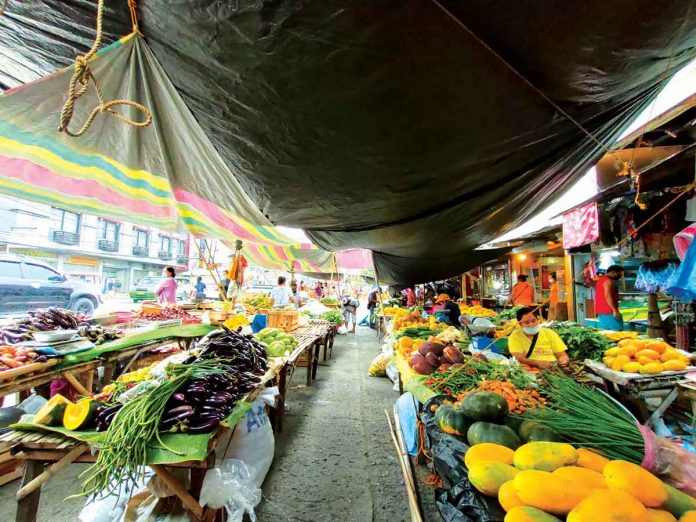
ILOILO – How can the Ilonggos survive the economic fallout of the coronavirus pandemic?
“Tighten their belts,” according to Provincial Statistics Officer Nelida Amolar of the Philippine Statistics Authority (PSA).
She warned of a possible uptick in the prices of retail goods this year, citing as an ominous sign the province’s high inflation rate in April this year– 3.9 percent, the highest since 2019.
Be resourceful, be entrepreneurial, said Amolar.
inflation is the rate of increase in prices over a given period of time.
“Mangita kita sang bagay-bagay nga olobrahon or anything entrepreneurial nga biskan gamay lang maka-augment sang income,” said Amolar.
Do away with unnecessary expenses, she advised Ilonggos.
“Indi lang anay, ipaiway lang anay. Reserve (money) for our health. Kon naga-leisure kaw sang una, bakal mo na lang sang vitamins kag pagkaon nga sustansya to avoid this pandemic kay even ang vitamins and pagkaon nagamahal man,” Amolar said.
The pandemic, she said, is adversely impacting the prices of goods.
“Nagmahal gid ang mga baraklon kag low ang supply,” Amolar said.
While the inflation in 2020 rose from that of 2019 due to the pandemic, Amolar said, Iloilo this year experienced some slight relief.
Inflation in this city and province of Iloilo dropped to 2.5 percent in August from 3.4 percent in July, making it the lowest recorded since the start of 2021.
While Iloilo hit 3.9 percent inflation in April, from there the rate of change in the Consumer Price Index (CPI) had a downward trend to date with May posting 3.8 percent and June, 3.6 percent, according to Amolar.
CPI is a measure of the average price of a standard “basket” of goods and services consumed by a typical family.
Meanwhile, last month’s inflation was 0.4 points higher than the 2.1 percent posted in August last year.
According to Amolar, there was a drop in CPI (from July to August this year) particularly in these commodity groups:
* Food and Non-Alcoholic Beverages – 3.8 percent, down by 0.6 percentage points
* Transport – 2.4 percent, down 0.2 percentage points
* Housing, Water, Electricity, Gas and Other Fuels (-2.3 percent deflation, down by 3.5 percentage points)
“Ang naga-contribute sang decrease amo ang daku nga pagnubo sang food and non-alcoholic beverages prices. More gid ang food commodity. Meaning subong nga July, nagmahal gid ‘ya ang pagkaon,” Amolar told Panay News.
Meanwhile, price indexes of other commodities like Education (8.4 percent), Communication (0.5 percent), and Furnishing Household Equipment and Routine Household Maintenance (0.9 percent) remained stable in August.
However, local statisticians noted an uptick in other commodity groups in August:
* Alcoholic Beverages, Tobacco, and other Vegetables-Based Tobacco – 14. 0 percent, an increment of 2.0 percentage points,
* Clothing and Footwear – 2.3 percent, higher by 0.2 percentage points
* Health – 0.6 percent, higher by 0.1 percentage points
* Recreation and Culture – 0.4 percent, increment of 0.1 percentage points
* Restaurant and Miscellaneous Goods and Services – 1.9 percent, higher by 0.1 percentage points
“In the month-on-month comparison, the CPI in all items posted at 0.9 percent (127.5 to 126.4) that may be also attributed to the downward movement of prices of some commodities during the period,” said Amolar.
Meanwhile, the average inflation rate for all items in 2020 almost doubled to 2.5 percent from previous year’s 1.3 percent, said Amolar.
“The 2020 monthly inflation rate in Iloilo posed erratic changes in the span of one year. The monthly inflation rate has increased to 2.7 in the last month of the year from the 2.6 percent in January 2020,” she added.
In 2020, the top three commodity groups that had the highest inflation rate were: Alcoholic Beverages, Tobacco and Other Vegetable-Based Tobacco Products (16.2 percent), Transportation (6.5 percent), and Furnishing, Household Equipment and Routine Household Maintenance (5.6 percent).
Here’s the month inflation rate breakdown in 2020: January (2.6 percent), February (2.7 percent), March (2.8 percent), April (2.4 percent), May (1.8 percent), June (2.6 percent), July (2.5 percent), August (2.1 percent), September (2.3 percent), October (2.1 percent), November (3.0 percent), and December (2.7 percent)./PN