


GAZA STRIP – The International Court of Justice (ICJ) has said Israel has a legal obligation to facilitate the delivery of humanitarian aid to the Gaza Strip by the United Nations (UN) and its entities to ensure the basic needs of Palestinian civilians there are met.
An advisory opinion from the UN’s top court also said Israel had not substantiated its allegations that the UN agency for Palestinian refugees (Unrwa) lacked neutrality or that a significant number of its staff were members of Hamas or other armed groups.The UN’s chief said he hoped Israel would abide by the “very important decision”.
But Israel rejected the ICJ’s opinion as “political” and insisted it would not cooperate with Unrwa, which it has banned.
The opinion is non-binding, but it carries significant moral and diplomatic weight.
In December, the UN General Assembly asked the ICJ for an opinion on Israel’s obligations, as an occupying power and a member of the UN, towards UN agencies and other international organizations operating in Gaza and the occupied West Bank, including East Jerusalem.
It came after the Israeli parliament passed laws banning any activity by Unrwa on Israeli territory and contact with Israeli officials.
The ICJ was asked to also cover in its opinion Israel’s duty to allow the unhindered delivery of essential supplies to Palestinian civilians.
Israel tightened its blockade on Gaza after the start of its war with Hamas two years ago and has since restricted – and at times completely stopped – the entry of food and other aid for the 2.1 million population.
Before this month’s ceasefire deal took effect, UN-backed global experts had warned that more than 640,000 people were facing catastrophic levels of food insecurity and that there was an “entirely man-made” famine in Gaza City.
Israel rejected the famine declaration, insisting it was allowing in sufficient food.
UN’s top court begins hearings on Israel’s legal duties towards Palestinians
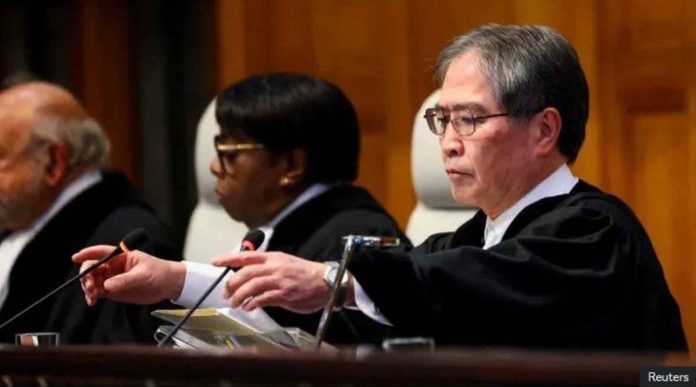
The ICJ’s President Yuji Iwasawa read out its advisory opinion at The Hague on Wednesday.
He said the panel of 11 international judges agreed that Israel, as an occupying power, was required to fulfill its obligations under international humanitarian law.
The first obligation was to “ensure that the population of the Occupied Palestinian Territory has the essential supplies of daily life, including food, water, clothing, bedding, shelter, fuel, medical supplies and services”, according to the judge.
The second was to “agree to and facilitate by all means at its disposal relief schemes on behalf of the population of the Occupied Palestinian Territory so long as that population is inadequately supplied, as has been the case in the Gaza Strip”.
The other obligations listed included respecting the prohibitions on forcible transfer from an occupied territory and on the use of starvation of civilians as a method of warfare.
Judge Iwasawa said the panel were also of the opinion that Israel had “an obligation to co-operate in good faith with the United Nations by providing every assistance in any action it takes in accordance with the Charter of the United Nations, including [Unrwa]”.
Israel was also obliged to ensure “full respect for the privileges and immunities accorded to the United Nations” and its officials, as well as for the “inviolability of the premises of the United Nations… and for the immunity of the property and assets of the organisation from any form of interference”, he added.
Reuters
Yuji Iwasawa, the president of the International Court of Justice, read out the advisory opinion
When asked about the advisory opinion in Geneva, UN Secretary General António Guterres said: “This is a very important decision. And I hope that Israel will abide by it.”
He added that the advisory opinion came at a moment in which the UN was doing everything it could to boost aid deliveries to Gaza and deal with the “tragic situation” there.
Unrwa’s Commissioner-General, Philippe Lazzarini, said the opinion was “unambiguous”.
“With huge amounts of food and other life saving supplies on standby in Egypt and Jordan, Unrwa has the resources and expertise to immediately scale up the humanitarian response in Gaza and help alleviate the suffering of the civilian population,” he wrote on X.
But Israel’s foreign ministry said it categorically rejected the advisory opinion, describing it as “entirely predictable from the outset regarding Unrwa”.
“This is yet another political attempt to impose political measures against Israel under the guise of ‘international law’,” it added.
The ministry also said Israel was fully upholding its obligations under international law and that it would “not co-operate with an organization that is infested with terror activities”.
Unrwa – the largest humanitarian organization in Gaza, with 12,000 Palestinian staff based there – has repeatedly denied Israel’s allegation that it is deeply infiltrated by Hamas, which is proscribed as a terrorist organization by Israel, the US, UK and other countries.
Israel has said that Unrwa staff took part in the Hamas-led attack on southern Israel on 7 October 2023, in which about 1,200 people were killed and 251 others were taken to Gaza as hostages, and claimed that the agency still employs more than 1,400 “Hamas operatives”.
The UN said last year that it had fired nine of Unrwa’s staff in Gaza after investigators found evidence that they might have been involved in the 7 October attack. Another 10 staff were cleared because of insufficient evidence.
Judge Iwasawa said the information the ICJ received was “not sufficient to establish Unrwa’s lack of neutrality”, and that Israel had “not substantiated its allegations that a significant part of Unrwa employees ‘are members of Hamas… or other terrorist factions'”. (BBC)