
[av_one_full first min_height=” vertical_alignment=” space=” custom_margin=” margin=’0px’ padding=’0px’ border=” border_color=” radius=’0px’ background_color=” src=” background_position=’top left’ background_repeat=’no-repeat’ animation=”]
[av_heading tag=’h3′ padding=’10’ heading=’URBAN FARMER | Production of organic fertilizer from biodegradable waste’ color=” style=’blockquote modern-quote’ custom_font=” size=” subheading_active=’subheading_below’ subheading_size=’15’ custom_class=”]
BY JULIO P. YAP JR.
[/av_heading]
[av_textblock size=” font_color=” color=”]
Friday, June 9, 2017
[/av_textblock]
[av_textblock size=” font_color=” color=”]
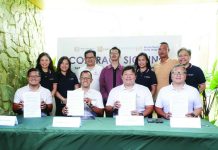
THE BUREAU of Soils and Water Management (BSWM) recently spearheaded the launching of its Training on Capacity Enhancement on the Operations of the Composting Facility for Biodegradable Wastes (CFBW) at the May’s Organic Garden in Bacolod City for the Visayan Cluster.
The establishment of CFBW is an integral part of the National Organic Agriculture Program (NOAP) where the agency will be turning over CFBWs in some provinces.
The conduct of these training sessions on the effective operation of composting facilities will be helpful to the identified beneficiaries.
Sen. Cynthia Villar, who was the guest of honor during the event, says that, “We really need to ensure the efficient implementation of Republic Act 10068, or the Organic Agriculture Act of 2010, which provides for the development and promotion of organic agriculture in the Philippines.
Under such Act, “at least five percent of Philippine agricultural farms will be converted into organic,” where 2016 was supposed to be the targeted deadline.
The contribution of organic to the overall growth and development of agriculture in the country, particularly in terms of sustainability, competitiveness and food security, relies heavily on the successful implement of NOAP.
The establishment of composting facilities is a very effective waste management practice, where the involvement of the local government units (LGUs) is crucial.
It is expected to boost the institutional capacities of LGUs in terms of sorting, collecting and composting community wastes.
Tons of biodegradable wastes are produced in the country, which could be converted to organic fertilizer through composting.
Soil nutrient management is an integrated system to manage soils, nutrients, and crops in a sustainable manner to optimize crop production and improve soil health.
To grow what we eat and to eat what we grow, we need healthy soils. We need to protect our prime agricultural lands from degradation which can come in the form of neglect as manifested by increased erosion or in the form of abuse such as over fertilization, excessive pesticide application, and intensive cropping system.
The BSWM says that organic fertilizers produced from agricultural residues (i.e. rice straw, animal manure, etc.) are intensively used as alternative to inorganic/synthetic fertilizers.
Considering that large amount of biodegradable wastes are also coming from markets and residences, there is a need to set-up facilities near markets, trading posts and residential areas that will convert those wastes into organic fertilizers/compost which could be used by farmers.
The Organic Agriculture Act promotes and encourages the establishment of facilities, equipment and processing plants or CFBW that would accelerate the production and commercialization of organic fertilizers and other inputs.
The CFBW is composed of one unit rotary composter, one unit shredding machine.
Locally, these machineries are produced by RU Foundry and Machine Shop Corporation.
It is in line with the priority thrust of NOAP and complements and supports DA plans and programs to increase crop productivity through sustainable agriculture.
One of the activities under the NOAP is the provision of composting facilities to farmers’ associations and cooperatives, LGUs, academe and civil society organizations. (jaypeeyap@ymail.com/PN)
[/av_textblock]
[/av_one_full]