
ILOILO – The provincial government will not rely on the national government to inoculate its population with coronavirus disease 2019 (COVID-19) vaccine once this becomes available.
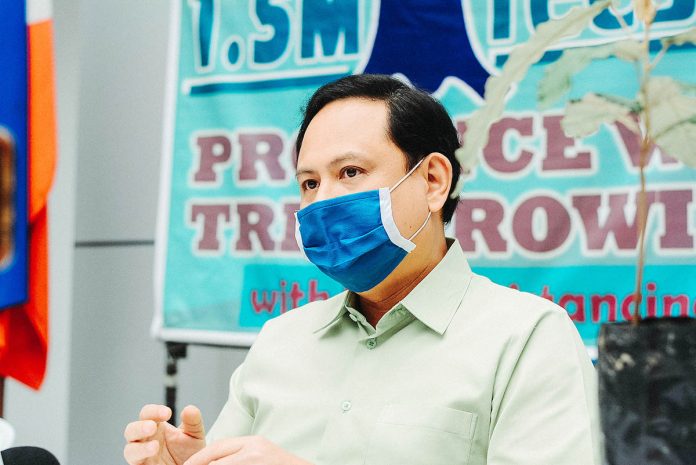
Gov. Arthur Defensor Jr. plans to utilize the budget for maintenance and other operating expenses (MOOE) if the provincial government could directly access the vaccines from credible manufacturers abroad and once such procurement gets the approval of the national government.
But he could not yet ascertain the amount of fund needed.
The national government has yet to allow local government units to directly access the vaccines. But according to Defensor, the Provincial Health Office (PHO) is now reaching out to credible vaccine makers abroad.
“Although we were advised by the national government that vaccines will be course through the Inter-Agency Task Force (IATF), our PHO is already looking sang kuluhaan,” Defensor said.
The Sangguniang Panlalawigan recently approved the province’s P2.608-billion executive budget for next year. Under the 2021 budget, P951,312,523 was allocated for personnel services and P1,055,839,460 was set aside for MOOE.
Earlier, vaccine czar Carlito Galvez Jr. said the Pfizer-BioNTech vaccine, which was rolled out already in the United Kingdom, may reach the country around the second half of next year. The vaccine is estimated to cost roughly P2,379 for the two required doses.
Other candidate vaccines are in the advanced stage of development and could be available also in 2021.
So, who gets the COVID-19 vaccine first?
According to Defensor, he instructed the PHO to draft guidelines on who would get priority in the distribution of the initial coronavirus vaccines once it is approved for domestic use.
Based on initial discussions, the governor said, frontliners, persons with comorbidities and those who cannot afford to purchase these vaccines are on top of the priority list.
As of Dec. 13, the province had a total of 2,836 COVID-19 cases – 241 active, 2,506 recovered and 89 dead.
Will capitol officials be among the first to receive the coronavirus vaccine?
Defensor said, “Unahon ta anay ang nagakinahanglan.”
The governor added that he would rather wait in line and prioritize his constituents.
For now, Defensor has yet to finalize the list of groups for vaccination, citing IATF’s own directive on vaccine prequalification.
The World Health Organization earlier recommended frontliners in health and social care facilities, the elderly who are over 65 years old, and those with underlying medical conditions that put them at higher risk of death, to be immunized first. These same sectors are also given priority under the plan of the Department of Science and Technology.
Health officials earlier said at least 70 percent of the population should receive two doses of the COVID-19 vaccine before Filipinos can develop “herd immunity” against the virus that has forced economies around the world to impose lockdowns and plunge into recessions.
People can catch COVID-19 from others who have the virus. The disease can spread from person to person through small droplets from the nose or mouth which are spread when a person with COVID-19 coughs or exhales.
These droplets also land on objects and surfaces around the person. Other people then catch COVID-19 by touching these objects or surfaces, then touching their eyes, nose or mouth.
The most common symptoms of COVID-19 are fever, tiredness, and dry cough.
Some patients may have aches and pains, nasal congestion, runny nose, sore throat or diarrhea. These symptoms are usually mild and begin gradually. Some people become infected but don’t develop any symptoms and don’t feel unwell.
According to the World Health Organization, most people (about 80 percent) recover from the disease without needing special treatment.
Older people, and those with underlying medical problems like high blood pressure, heart problems or diabetes, are more likely to develop serious illness./PN