


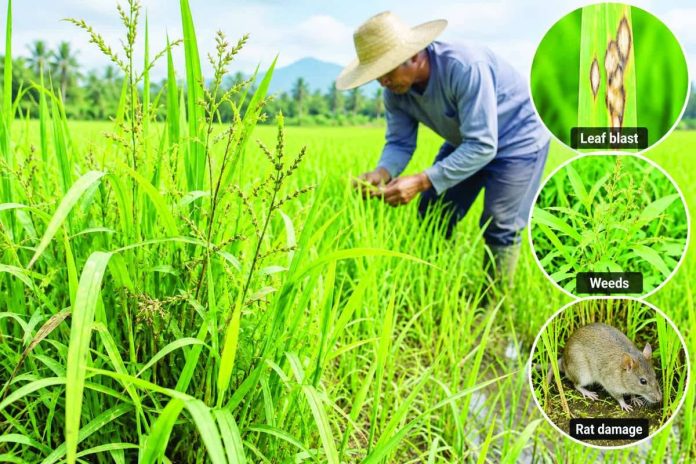
ILOILO – Weed infestation has emerged as a major threat to rice production in Western Visayas, with regional weed cover climbing to 9.42 percent in August — nearly double the level at which significant yield losses may occur — even as overall pest pressure remained low to moderate.
The Department of Agriculture – Western Visayas Regional Crop Protection Center (DA-RCPC) also flagged a rising incidence of leaf blast and renewed rat damage, prompting calls for closer surveillance and timely intervention in rice farms across the region.
The RCPC’s August 2026 pest and disease bulletin showed that nearly half of monitored rice fields remained in the vegetative stage, while about 20 percent had reached the reproductive or ripening stages.
The crop stages leave a substantial portion of rice farms vulnerable to pests and diseases affecting vegetative growth, while fields nearing maturity face threats that could directly affect grain formation and yields.
WEEDS TOP CONCERN
Of the threats monitored, weeds stood out as a priority management concern.
Regional average weed cover reached 9.42 percent in August, continuing an upward trend observed from June to August.
The RCPC noted that weed cover exceeding 5 percent throughout the crop cycle could result in significant yield losses.
With nearly half of monitored fields still in the vegetative stage, uncontrolled weeds could continue competing with rice plants for nutrients, water, sunlight and growing space.
The RCPC recommended early and timely weed management, preventing weeds from reaching their reproductive stage, and combining cultural, mechanical and chemical control methods instead of relying exclusively on herbicides.
Farmers were also advised to closely monitor fields during the early vegetative period.
LEAF BLAST ON THE RISE
Leaf blast recorded the highest incidence among rice diseases monitored in August at 1.39 percent, followed by bacterial leaf blight at 0.88 percent and brown spot at 0.36 percent.
Leaf blast showed a noticeable increase compared with June and July, making it the most prevalent disease recorded in the August bulletin.
The increase could be associated with conditions favorable to disease development, including prolonged leaf wetness, high humidity and the planting of susceptible rice varieties.
The RCPC urged farmers to intensify monitoring for blast lesions, apply balanced fertilizer and avoid excessive nitrogen, maintain proper plant spacing and good field management, and use resistant or tolerant varieties where appropriate.
Fungicides should be applied only when economically justified and according to recommended labels, it added.
INSECT PRESSURE LOW
Insect pest pressure, meanwhile, remained generally low.
Deadheart incidence stood at 0.67 percent, while whiteheads were recorded at 0.56 percent and rice bug incidence at only 0.01 percent.
Whitehead incidence, an indication of stem borer damage, increased sharply in July before declining in August. Deadheart incidence also dropped considerably from its June level.
The extremely low rice bug incidence indicated no significant regional pressure from the pest during the monitoring period.
The RCPC said the figures do not justify broad or calendar-based insecticide spraying. Farmers should instead continue regular field scouting while preserving beneficial insects and other natural enemies of rice pests.
RAT DAMAGE CREEPS UP
Rat injury also warrants closer attention after declining from June to July before increasing again in August to a regional average of 0.27 percent.
“Although the current incidence is relatively low, the upward trend is worth monitoring because rats can cause damage at multiple stages of rice growth, particularly near reproductive and ripening stages,” the RCPC advisory said.
The agency recommended community-based rat management instead of farmers controlling rats independently in individual fields.
Measures include field sanitation, removal of possible rat shelters, synchronized community trapping, management of vegetation along rice field bunds, and coordinated control efforts among neighboring farmers.
Despite the generally low to moderate pest situation, the RCPC urged farmers not to become complacent as more rice fields advance toward their reproductive and ripening stages.
Farmers were advised to strengthen regular field scouting and adopt timely Integrated Pest Management (IPM) rather than resorting to preventive pesticide applications.
Surveillance should particularly focus on leaf blast in vegetative fields and weed infestation, while farmers should continue watching for stem borer damage, rats, rice bugs and planthoppers.
With weed cover already at 9.42 percent, timely intervention could be crucial in preventing an otherwise manageable field problem from cutting into Western Visayas’ rice harvest./PN