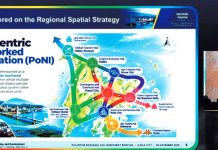




THE DEPARTMENT of Economy, Planning, and Development (DEPDev) has sounded a timely warning: Western Visayas must abandon fragmented, city-centered development and transform its provinces and cities into interconnected engines of growth.
Why? Because economic progress is hollow when prosperity is concentrated in a few cities while surrounding communities remain trapped in poverty and underdevelopment. This is the reality Western Visayas must confront if it genuinely aspires to become a competitive and inclusive regional economy.
This, without a doubt, is a challenge to the entrenched culture of parochial governance, where local governments often compete for investments instead of cooperating to create shared prosperity.
DEPDev’s proposed Polycentric Networked Integration Framework offers a promising alternative. It envisions specialized economic hubs, with Iloilo City serving as a governance and services center, Passi City as a convergence hub, Roxas City as an agri-fisheries center, and other localities capitalizing on their respective strengths.
But impressive development blueprints mean nothing without political will. Regional prosperity must take precedence over political boundaries, local rivalries and narrow ambitions.
More troubling is the region’s industrial weakness. Despite its agricultural and marine resources, Western Visayas lacks sufficient manufacturing and processing industries to transform raw products into higher-value commodities.
Farmers and fisherfolk produce the resources, yet much of the greater economic value is captured elsewhere. A region that produces wealth but fails to capture its value is not maximizing development. It is exporting opportunity.
Investments in processing facilities, manufacturing, reliable electricity and efficient logistics must therefore become urgent priorities. Likewise, major infrastructure projects must connect producers to markets and communities to economic opportunities, not merely provide politicians with monuments to their administrations.
Above all, regional integration demands action, not another round of conferences, ceremonial agreements and grand declarations. Governors, mayors and national agencies must coordinate investments, establish measurable targets and deliver tangible results.
Western Visayas does not lack resources, talent or economic potential. What it lacks is sufficient coordination to transform individual strengths into collective prosperity, and the result: uneven progress, duplicated investments, missed opportunities and economic disparities that persist despite the region’s considerable resources.
Development is not a contest in which one province or city or municipality must lose for another to win. When local economies complement rather than compete with one another, prosperity can multiply.
The region has spent enough time celebrating isolated pockets of progress while other communities wait for development to reach them. Western Visayas must now stop thinking as separate political territories and start acting as one economic powerhouse. Otherwise, its greatest obstacle to prosperity will not be a lack of resources, but the failure of its own leaders to work together.
A region divided by competing ambitions will remain weaker than the sum of its parts. And Western Visayas cannot afford to let political boundaries become permanent barriers to shared prosperity.