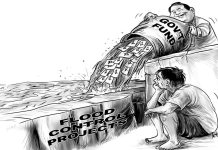

FLOODWATER does not knock. It slips under the classroom door, pools on the floor, and turns the chalk tray into a narrow canal. Children lift their bags to save notebooks. A teacher, sleeves rolled, cuts the power and hoists the CPU onto a higher shelf. Outside, a tarp boasts of a flood project “finished ahead of schedule.” Inside, the math lesson becomes a lesson in survival.
This is where accountability stops being abstract. It smells like damp paper, sounds like chairs scraping to higher ground, and feels like parents waiting at the gate because the road is knee-deep again. When safety funds drift elsewhere, schools become basins. The cost is lost learning, lost income, and lost trust.
We blame a few big names, then stop. Yet decay often hides in small habits: the “pwede na iyan” poured like weak cement, a shortcut that saves a week but cracks a year later, a signature traded for favors, the belief that rules bend for those with friends. This is not about scolding people trying to get by. It is about noticing how small lapses—a “minor” lagay, a wink, a shrug—pile up into a culture that excuses bigger sins. Culture is not a slogan. It is what we do when no one is watching.
Global voices echo what barangays already know. The World Bank has warned that weak governance builds fragile infrastructure. The International Monetary Fund reminds us that corruption does not just slow recovery—it magnifies the damage. The Asian Development Bank stresses that open bidding and honest audits cut leakages and improve services. These are not abstractions. They are the culvert that clogs after one rain, the dike that fails its first test.
Disasters are not only “acts of God.” Too often, they are worsened by human choices, by “acts of greed.”
Teachers feel this first. Classes are suspended, modules are soaked, attendance slips. A science teacher pivots from experiments to catch-up lessons. A mother loses a day’s wage to fetch a child sent home early. A guidance counselor comforts a student anxious about another midnight flood.
The ripples spread: anxiety climbs, discipline frays, performance dips. We are resilient, yes, but resilience should not excuse poor work. A dike that holds is mental health support—it keeps life steady.
Still, cultures can shift. In one school, students ended the day with a simple exercise: “What lifted trust today? What broke it?” In another, Grade 9 students mapped clogged drains around campus and sent the photos to the city engineer. Weeks later, workers cleared them before the next storm.
A small act, but a big habit: ask, verify, insist, and say thank you when government delivers. Conscience and civic muscle can grow together, one careful step at a time.
But habits need systems behind them. Honesty has to be easier, and cheating harder. Contracts, costs, and inspection reports should be public and searchable. Projects should be pinned on maps with photos before and after rains. Budget meetings should be open, last-minute insertions disclosed, and their sponsors named. Whistleblowers must have legal aid, risk protection, and job security. Parents’ associations and teacher groups deserve seats on monitoring boards. Fraud thrives in shadows; it struggles in daylight. (To be continued)/PN