


ILOILO City – A magnitude 4.3 earthquake jolted Iloilo and Guimaras on Wednesday morning, triggering evacuations at key government buildings and prompting authorities to heighten public vigilance amid fears of aftershocks.
The tremor struck at around 9:21 a.m., with its epicenter located approximately eight kilometers southwest of Guimbal, Iloilo, at a depth of 10 kilometers, according to the Philippine Institute of Volcanology and Seismology (Phivolcs).
Shaking was felt across several areas, with the strongest recorded in Jordan, Guimaras at Intensity III, a level that can cause noticeable indoor shaking and alarm residents.
Iloilo City, including City Hall, experienced Intensity II, while San Lorenzo, Guimaras reported a lighter Intensity I.
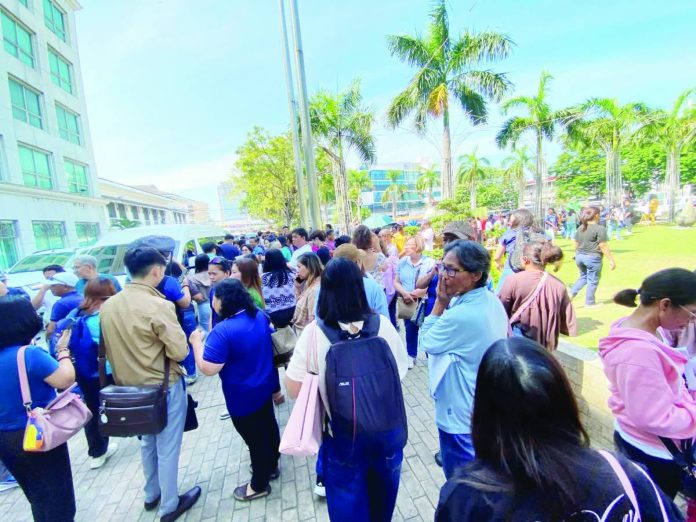
The sudden jolt prompted immediate evacuations, including at the Iloilo Provincial Capitol where employees and visitors were ordered to exit the building as a precautionary measure.
Authorities later confirmed that all personnel were safe, and normal operations resumed shortly after safety checks were completed.
Evacuations were also carried out at the Hall of Justice located at the New Castle Hotel, where court employees, judges, and litigants were directed outside following the tremor.
Phivolcs attributed the earthquake to tectonic activity, underscoring the region’s vulnerability due to its proximity to active fault systems.
While aftershocks remain possible, authorities said no significant damage to infrastructure is expected.
Phivolcs has identified the active West Panay Fault as an earthquake trigger.
The West Panay Fault is a 90-kilometer fracture cutting across Panay Island, capable of unleashing destruction. It runs through some of Iloilo’s most populated and fast-developing municipalities — San Joaquin, Miag-ao, Igbaras, Tubungan, Leon, Alimodian, Janiuay, and Lambunao — extending northward toward Tapaz in Capiz and Libacao in Aklan.
The “Lady Caycay” earthquake of January 25, 1948, tore through Panay Island with a magnitude of 7.8, killing at least 21 people, injuring dozens, and destroying 55 churches — 17 of which collapsed completely. In Iloilo alone, belfries and stone churches in Jaro, San Joaquin, and Arevalo fell in ruins. The ground cracked open and waves surged along the Iloilo Strait. That event remains the second-strongest earthquake in Philippine history.
In the wake of yesterday’s earthquake, officials intensified calls for preparedness, stressing that earthquakes can strike without warning.
“Earthquakes can happen anytime, anywhere, and without warning. Know how to prepare. Be alert. Be safe. Be informed,” said Raul Fernandez, regional director of the Office of Civil Defense (OCD) Region 6.
To improve readiness, the agency urged the public to take precautionary measures, including identifying evacuation routes, securing heavy furniture, preparing emergency “Go Bags,” and participating in regular earthquake drills.
“Familiarity breeds confidence,” Fernandez stressed, adding that knowing what to do during an earthquake can significantly reduce panic.
Authorities also emphasized the importance of strengthening community awareness and conducting regular simulation exercises to build long-term resilience against seismic hazards./PN