


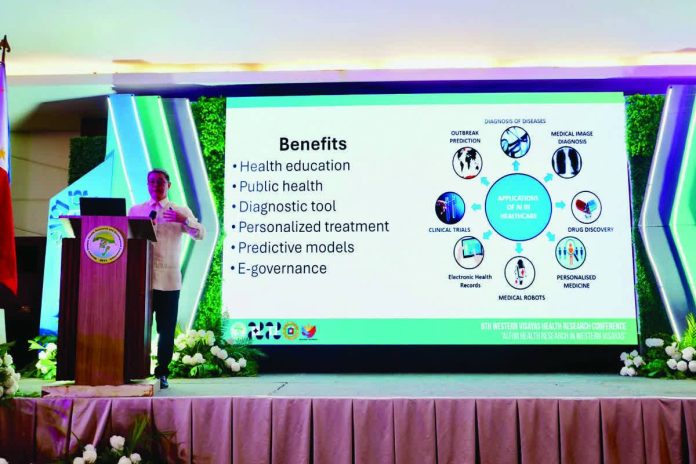
ILOILO City – Artificial intelligence (AI) is emerging as a potential game-changer in addressing healthcare disparities in Western Visayas, with experts emphasizing its role in improving disease diagnosis, data management, and equitable access to medical services, particularly in remote communities.
This was the central message of the 6th Western Visayas Health Research Conference, themed “AI for Health Research in Western Visayas,” which ran from October 28 to 30.
The three-day event gathered more than 300 researchers, health officials, and private sector representatives to explore how AI can revolutionize public health service delivery in the region.
The conference was organized through the collaboration of the Department of Science and Technology (DOST) Region 6, the Western Visayas Health Research and Development Consortium, the Department of Health (DOH), and the DOST–Philippine Council for Health Research and Development.
Dr. Aimee Marie Gayomali, head of the DOH-WV CHD non-communicable diseases cluster, underscored AI’s transformative potential in detecting and managing diseases, particularly tuberculosis (TB).
“AI can expedite the diagnosis for patients, particularly in initial screenings, helping us identify those who are in dire need of services,” Gayomali said, noting how technology can ease the burden of limited healthcare personnel in far-flung areas.
She emphasized that AI should be viewed as an aid, not a replacement, to human workers.
“For Western Visayas, the challenge is number one is data and number two is manpower. So, everybody has said that AI is not there to replace human beings, but AI should aid the health workers to do their job in the public service, in the public sector,” she added.
DOST secretary Renato Solidum, who also addressed the gathering, reminded that technological progress should translate to inclusive healthcare.
“Ours is a deeper calling: to ensure that innovation reaches every barangay, every island, and every Filipino family, no matter how distant, no matter how small,” he said.
University of the Philippines–Manila Chancellor Dr. Michael Tee agreed, stressing that AI-driven data analysis can help craft more responsive health interventions and streamline workflows across local health systems.
Meanwhile, DOST regional director Rowen Gelonga revealed that the agency is already preparing the region for AI integration through multi-sectoral partnerships.
“We are one in consonance with other stakeholders. It’s not only the government exerting effort but also the private sector,” he said.
Beyond showcasing research, this year’s conference aims to convert academic discussions into actionable policies that can improve the quality of life of Western Visayans. Organizers hope the event will help shape a future where technology and compassion work hand in hand to build a more efficient, data-driven, and inclusive public health system./PN