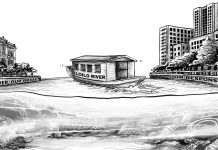



ONLY 11 out of 43 local government units in Iloilo Province meet the national standard for safely managed drinking water, according to the provincial government itself. That means the majority of Ilonggos live in areas where water may not be consistently available, may not be accessible within their homes, and — most troubling of all — may not be safe to drink.
Why are the Ilonggos in this dire situation?
The standards are clear. The risks are known. The consequences — water-borne diseases, public health threats, deepening inequality — are well documented.
So the question must be asked, plainly and without hesitation: who is responsible?
For too long, the answer has been diffused across layers of government, lost in bureaucratic language, or softened by references to “budget constraints” and “long-term plans.” But when it comes to something as basic as safe drinking water, ambiguity is not acceptable. Accountability must be demanded.
Local government units are on the frontline. They are tasked with ensuring water service delivery, monitoring sources, and protecting the health of their communities. Yet many LGUs in Iloilo admit they cannot even conduct regular water quality testing due to lack of funds. Testing for fecal contamination — a basic requirement — is irregular. Monitoring is inconsistent. Compliance is incomplete.
If LGUs are unable to meet these minimum obligations, then the question is not just about capacity — it is about prioritization. Where are the funds going? What programs are being prioritized over water safety? And why is something so essential still treated as negotiable?
But the burden does not rest on LGUs alone.
National agencies set the standards. The Department of Health defines what constitutes safe water. Policymakers in Manila craft the frameworks and targets. Yet setting benchmarks without ensuring that local governments have the resources to meet them is, at best, incomplete — and at worst, irresponsible.
Accountability, therefore, must extend upward.
Where is the sustained funding support to ensure that every LGU can conduct regular testing? Where are the enforceable mechanisms to ensure compliance — not just recommendations, but consequences? Where is the urgency from national leadership when basic water safety targets are clearly not being met?
It is not enough to issue guidelines and expect local governments — many of them resource-strapped — to carry the burden alone.
Then there is the matter of plans.
The Iloilo Province Integrated Water Security Plan promises a better future: 24/7 access, safe and sufficient supply, climate-resilient systems. It is comprehensive, well-intentioned, and necessary. But it is also long-term. And while the plan looks toward 2035, communities today are still drawing water from sources that may be unsafe.
A plan does not absolve responsibility. It does not excuse present failures. If anything, it raises expectations — and with it, the demand for measurable, immediate progress.
Because water safety is not a future goal. It is a present obligation.
The deeper problem in Iloilo is not the absence of policies or awareness. It is the absence of consequences. When LGUs fail to meet standards, what happens? When testing is skipped, who answers for it? When households are exposed to unsafe water, who is held accountable?
Silence, in this case, is complicity.
Accountability must be built into every level of the system. LGUs must be required to report regularly on water quality and access — and those reports must be transparent and accessible to the public. National agencies must not only monitor compliance but enforce it, with clear support mechanisms for those who lack capacity and firm penalties for persistent neglect.
Most importantly, the public must be part of this accountability chain. Communities have the right to know the quality of the water they consume. They have the right to demand action when standards are not met. And they have the right to hold their leaders — local and national — answerable.
Because at the end of the day, this is about something far more basic, far more human.
Every drop of water carries with it a responsibility.
A responsibility to ensure it is safe.
A responsibility to ensure it is accessible.
A responsibility to ensure it does not harm the very people it is meant to sustain.
In Iloilo, that responsibility is being shared — but not sufficiently shouldered.
Until it is, the question will continue to echo: If the water is unsafe, who will answer for it?