



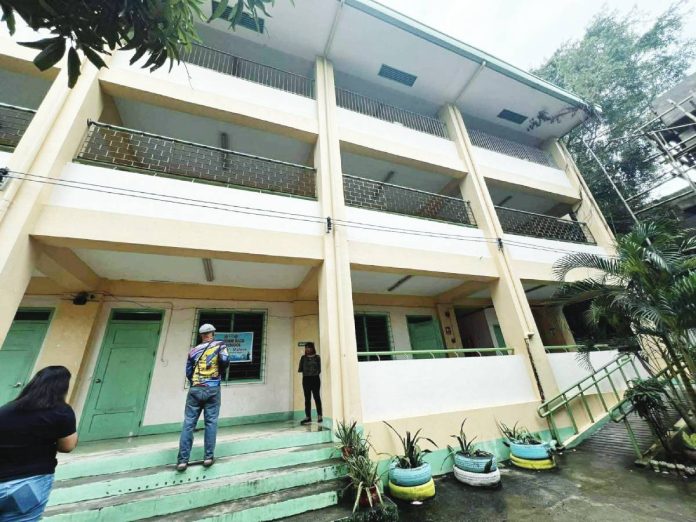
ILOILO City – The city government is moving to institutionalize a clear, automatic protocol for class and work suspensions in the wake of earthquakes — a first for Iloilo City — following the recent tremors in Cebu and Davao that rattled Western Visayas.
Mayor Raisa Treñas said the new guidelines, crafted after consultations with the City Disaster Risk Reduction and Management Council (CDRRMC) and its Disaster Response Cluster, aim to eliminate confusion during emergencies.

“The purpose of this protocol is to have a clear basis for suspending classes and work whenever an earthquake occurs,” Treñas explained.
Under the proposed system, magnitude 3 to 4 tremors will trigger building inspections in schools.
Teachers will check for cracks or structural damage and submit reports to their principals. If facilities are deemed safe, classes will continue; otherwise, immediate suspension will follow.
“The safety of students and personnel remains our priority,” Treñas stressed. “If inspections confirm that buildings are stable, classes can proceed. But if there are risks, we will not hesitate to suspend them.”
For government offices, the Office of the Building Official (OBO) will conduct structural checks before resuming work.
However, once a quake reaches magnitude 5 or higher, both classes and government operations will be automatically suspended to ensure public safety.
Treñas said the policy will take effect once information dissemination and orientation sessions are completed across schools, barangays, and offices.
“This protocol will take effect after we complete the information dissemination,” she said.
The mayor emphasized that the move reflects the city’s proactive stance after two major tremors — a magnitude 6.9 earthquake in Bogo City, Cebu on September 30 and a magnitude 7.4 quake in Davao Oriental on October 10 — both felt across Iloilo City.
“These recent earthquakes remind us that preparedness and clear communication are essential,” Treñas said. “Through this protocol, we want to make sure that everyone knows what to do, where to go, and how to respond safely.”
The strongest earthquake ever to strike Panay Island – and Iloilo City for that matter – hit on January 25, 1948 — a magnitude 7.8 tremor that came to be known as the “Lady Caycay” quake.
With its epicenter near Anini-y, Antique, the quake registered a Mercalli intensity of X (“Extreme”), tearing open fissures as wide as four meters across Iloilo and Antique.
The shaking even triggered a small tsunami along the Iloilo Strait that reportedly claimed two lives.
At least 21 people were killed and 43 others injured. Fifty-five Spanish-era churches were damaged, 17 of them collapsing entirely.
In Iloilo, historic belfries in Jaro, San Joaquin, and Arevalo toppled. Bridges crumbled, buildings gave way, and the land itself split open.
The “Lady Caycay” earthquake remains the second-strongest in Philippine history, next only to the 7.8-magnitude Luzon earthquake of 1990./PN