

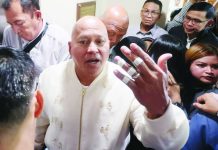


WHO said Bacolod City Lone District Rep. Albee Benitez’s public apology to Councilor Homer Bais on Wednesday, October 21, was an act of humility?
The public apology, posted on his Facebook account, came five days after the infamous table-slamming incident that unfolded in full public view during a MassKara dinner at the Bacolod City Government Center lobby on October 16.
The billionaire congressman should have apologized right there and then, immediately after the incident. Or, at the very least, the following day. But he did neither.
News of the distasteful encounter on October 16 spread like wildfire across Bacolod and social media, even as the MassKara Festival reached its highlights on October 17 and 18. The controversy subsequently spiraled beyond control, attracting attention and sparking discussions even beyond the country’s borders.
Matters worsened when three of Albee’s political allies — councilors Al Victor Espino and Caesar Distrito, and Tangub barangay captain Noli Villarosa — entered the fray on Monday morning, October 19. Villarosa held a press conference with selected members of the media, while Espino and Distrito went out of their way to grant radio interviews.
Apparently attempting to change the narrative and shift part of the blame onto Homer, the three demanded that Homer apologize to the congressman or face sanctions from their political group, Team Asenso.
But their intervention did little to extinguish the fire. Instead, public sentiment against Albee intensified.
CATTY COMMENTS
Next attempt: an official press statement.
On Monday afternoon, October 19, Albee’s camp released a seven-paragraph statement emphasizing transparency — a principle the congressman has consistently championed.
This was followed by statements of support from various barangay councils in Bacolod, professing their wholehearted love and support for Albee and his much-vaunted commitment to transparency.
But transparency was hardly the issue at that moment. What the public wanted to know was simple: Why did Albee bang the table?
Unfortunately, his camp failed to confront that crucial question — one that raised serious concerns about his temperament and decorum, not merely as a congressman but as a Deputy Speaker of the House of Representatives. Thus neither Albee’s official statement nor the declarations of support from barangay councils succeeded in calming the public uproar.
By Tuesday, October 20, the backlash had grown into a devastating wave of criticism. Facebook was flooded with catty, sarcastic, and downright savage comments directed at the congressman. And the political heat showed no signs of subsiding.
AT WIT’S END
Apparently backed into a corner and running out of options, Albee finally recorded a video apologizing to Homer and the people of Bacolod for his behavior on the night of October 16. He posted the video on his Facebook page shortly before 6 p.m. on Wednesday, October 21.
In his apology, he acknowledged that public officials must learn to manage their emotions, particularly when dealing with others in public.
Predictably, praises soon poured in, with supporters describing the congressman as humble and sincere.
But there was an awkward twist. Albee’s apology effectively turned the earlier pronouncements of Espino, Distrito, and Villarosa into a comedy of errors. After all, they had demanded an apology from Homer, only for their political leader to end up apologizing. What an embarrassing reversal!
Unimpressed netizens were quick to remark: “Too late the hero.”
Others were even more savage: “The apology is a good start, but we still need the Commission on Audit to look into projects funded by the P4.4 billion loans for the sake of transparency.”
To me, the explanation for Albee’s eventual public apology to Homer is straightforward. He succumbed to the might of the many. Nothing more, nothing less.
MORAL LESSON
The moral of the controversy is simple and universally relevant: Nobody possesses “unli” or unlimited power — not even the billionaires and trillionaires of this world. Unlimited power belongs only to Almighty God.
Indeed, Homer’s savage and caustic retort during his encounter with Albee — “Ti, ano kung Benitez ka!?” — may well have served as a moment of divine providence for the congressman. It was a rude awakening to a fundamental political reality: He may command the loyalty of many, but certainly not everyone.
The controversy also appeared to shake the foundations of Albee’s political empire in Bacolod and Negros Occidental, exposing its vulnerabilities in just a matter of days.
Homer’s defiant words may therefore resonate far beyond that heated encounter, serving as a powerful reminder to the Benitezes of Negros Occidental that political influence has its limits. It is a reminder to exercise restraint and conduct themselves with humility and respect. For Bacolodnons and Negrosanons are not necessarily intimidated by wealth, political connections, or a powerful family name. And eventually, they fight back.
The collective power of ordinary citizens can outweigh even billions of pesos. So never underestimate the might of the people. Those who do may eventually find themselves overwhelmed by the very public they thought they could control.
In this controversy, Homer has emerged as a symbol of the defiant Bacolodnon and Negrosanon spirit: “Maisog, gani wala nahadlok bisan pa sa bilyonaryo!”
In a nutshell, the lesson of this entire episode is unmistakable: Albee tested the waters — and got burned!/PN