


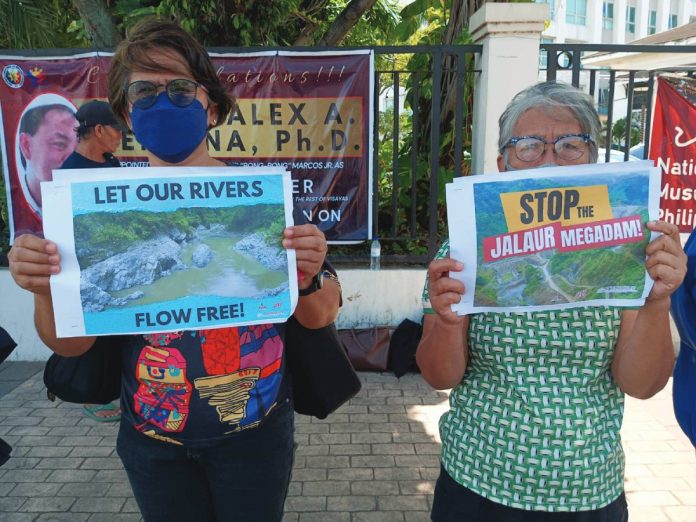
ILOILO — Indigenous rights groups have renewed their demand to stop the Jalaur River Multipurpose Project II (JRMP II), warning that the controversial mega dam in Calinog town threatens to uproot thousands of Tumandok families, destroy ancestral lands, and erase cultural heritage.
The Katribu Kalipunan ng Katutubong Mamamayan ng Pilipinas, a national alliance of Indigenous Peoples organizations, said the project, when fully operational, is set to displace more than 17,000 people and has already led to grave human rights abuses.
The group recalled that on December 30, 2020, nine Tumandok were killed and 16 others arrested in what they called a “massacre” linked to resistance against the dam.
“Today, join us as we drumbeat our calls: Stop the construction of the Jalaur Mega Dam! Justice for the Tumandok Massacre victims. The National Irrigation Administration (NIA) and National Commission on Indigenous Peoples, as well as the Philippine National Police, Armed Forces of the Philippines, and National Task Force to End Local Communist Armed Conflict, should be held accountable for permitting the construction of the Jalaur Mega Dam and killings of the people in resistance,” the group said in a public statement.
They added: “And yet, from 2011 to 2025, the resistance of the Tumandok against the flood of injustice persists. It is just to fight land plunder and human rights violations, carrying their rights to ancestral lands and self-determination.”
On Aug. 26, the Jalaur River for the People’s Movement (JRPM) marked the International Day of Solidarity and Action for the Tumandok People with protests in Iloilo City and South Korea. The campaign sought international pressure against the dam, including complaints filed before South Korea’s grievance mechanisms against dam project funder Korean Export-Import Bank (KEXIM) and contractor Daewoo Engineering & Construction. Activists allege violations of OECD guidelines, disregard for safety, and the absence of Free, Prior, and Informed Consent (FPIC) from affected Tumandok communities.
In Iloilo City, local progressive groups also staged a protest outside the Iloilo Provincial Capitol in solidarity with Tumandok opposition.
Tumandok communities have resisted the dam, citing not only the threat of displacement but also what they see as a broader struggle for human rights, environmental protection, and cultural survival. They have faced legal battles, intimidation, and violence, but remain resolute in defending their ancestral domain.
However, NIA Region 6 officials insist the project is critical to Iloilo’s future. Project spokesperson Steve Cordero said halting the dam would harm farmers and residents alike.
“Are we really going to deny these communities the critical benefits that this project offers based on unsubstantiated claims from individuals who may be acting with malice or who could simply be misinformed?” Cordero asked.
He stressed that the dam would provide irrigation to agricultural lands, a stable water supply to households, flood mitigation, and renewable energy.
“The well-being of the residents of Iloilo should carry significant weight in our considerations,” he said.
The P11.2-billion JRMP II, funded partly by a Korean loan, includes a 109-meter high dam, a 38.5-meter afterbay dam, a 10-meter catch dam, and an 80.74-kilometer high-line canal.
It is expected to deliver irrigation to 31,000 hectares of farmland, generate 6.6 megawatts of hydroelectric power, create opportunities for inland fishing and ecotourism, and secure water supply for Iloilo City and nearby towns.
The project is slated for completion by late 2025 or early 2026./PN