




NEGROS OCCIDENTAL – The municipality of Isabela will go down in history as one of the staunchest advocates for the rights and welfare of Indigenous Peoples in the province of Negros Occidental.
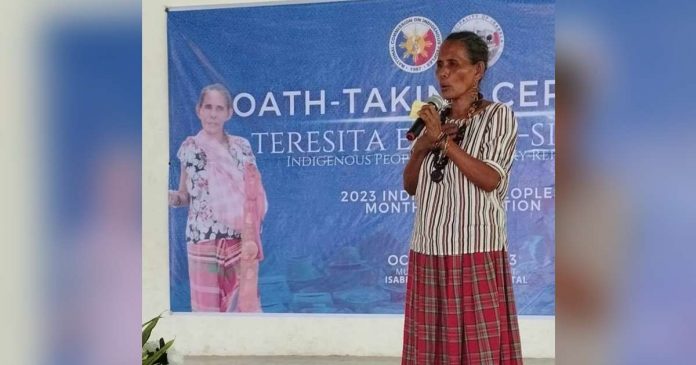
Earlier in October, Mayor Irene Montilla swore into office Teresita Enario Sinceda, the town’s first Indigenous People Mandatory Representative (IPMR) in the municipal council. She will represent around 10,000 IPs residing across eight barangays in Isabela.
“The Lord has planned this day so that we, IPs, will feel that we are not slaves but partners for development and a partner of all. We now have a voice!” Sinceda said.
The 68-year-old, fondly called “Dayco,” happens to be the first woman IPMR from the Ati tribe in Western Visayas to be formally installed into office and become a regular member of a Sanggunian.
Kabankalan City was the first to comply with the provisions of Republic Act 8371, or the Indigenous Peoples Rights Act (IPRA) of 1997, when it installed Jeorge Largado on its city council. Largado later became a Commissioner for Island Groups and the rest of the Visayas of the National Commission on Indigenous Peoples (NCIP).
IPRA Section 16 gives Indigenous Cultural Communities or Indigenous Peoples Structures the right to participate in decision-making that affects their rights, lives, and future. The law prompted the Department of Interior and Local Government to provide initial guidelines for including IPMRs in local legislative councils.
Also, NCIP Administrative Order No. 3, Series of 2018, as amended by NCIP Administrative Order No. 1, Series of 2021, or “Revised National Guidelines for the Mandatory Representation of Indigenous Peoples in Local Legislative Councils and Policy-making Bodies,” reaffirmed this provision.
Sinceda said she would champion the IPs’ aspirations for self-governance and empowerment, where people around them respect their unique culture without discrimination.
“We want to resolve tribe members’ conflicts our way, and if there is no resolution reached, we will issue a certificate to the barangay endorsing the matter,” she said.
According to her, an Ati local council comprises men and women, with “Ibu” meaning man, or ‘Kaibuan’ collectively. In contrast, a woman council member is called “Ubayi,” or “Kaubayian” as a group.
A nomadic feature in their way of life called “ranso” is still very much observed, and Sinceda wants the public to respect this practice. This means that on particular days of the year, they go to any town or city in the province to sell their products, like herbal medicines and woven products.
They also take this opportunity to gather roots and leaves called “pangalap,” which they use for their concoctions that are abundant in specific areas of the province. They may also hunt non-threatened wild animals or “pangayam.”
Sinceda is thankful for the government’s support, including education subsidies, seedlings, and farm machinery.
“We already have several college graduates working in the government, such as agriculturists, midwives, coast guards, police, and teachers, but I would like to have more college graduates from our tribe so we can have more professionals,” she said. “Gradually, we feel less discriminated against because we are now better informed and empowered.”
There are two more things on her list, though, that the Ati community would want to have: irrigation and a museum.
“We have 110 hectares of land, and irrigation is essential for us, while a museum will showcase our culture. We want them preserved in that room for our next generation to see,” she said.
She said she was ready to sit at the town’s Sangguiang Bayan and urged her fellow IPs to support her leadership for the development of their community. (PIA)/PN