


BACOLOD City — The Bacolod City Government has intensified its campaign against African Swine Fever (ASF) by conducting random testing on backyard hog farms in Barangay Taculing as authorities work to determine whether the virus has spread beyond the city’s first confirmed cases.
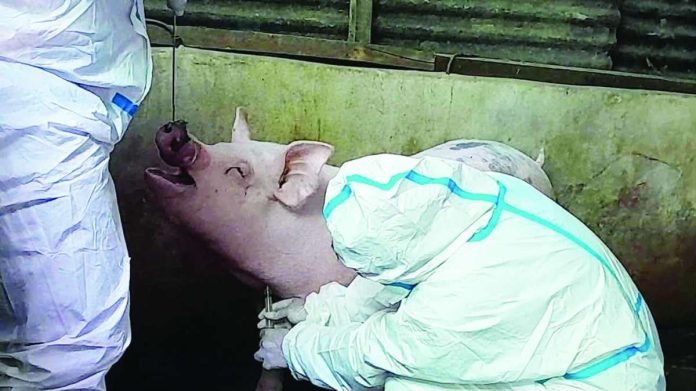
The City Veterinary Office (CVO), a member of the ASF Task Force created by Mayor Greg Gasataya, collected blood samples from pigs raised by three backyard hog raisers in Purok 5, Barangay Taculing, where Bacolod’s first ASF-positive case was detected.
The sampling covered farms within the 500-meter control zone surrounding the infected area to assess whether the virus remains contained or has spread to nearby communities.
Collected samples have been submitted to the Department of Agriculture–Western Visayas Regional Animal Disease Diagnostic Laboratory for confirmatory testing.
Personnel from the Bacolod City Police Office and Barangay Taculing assisted the veterinary team during the sampling operation.
Authorities said strict biosecurity protocols were observed throughout the activity, including the use of personal protective equipment, disinfection before moving to another site, and the proper disposal of used materials to prevent contamination.
The CVO urged hog raisers and residents to remain vigilant and comply with disease prevention measures to help curb the spread of ASF.
City veterinarians earlier announced that random testing would also be conducted in other barangays as part of expanded surveillance following the city’s first confirmed ASF cases.
Under Bacolod’s containment strategy, all pigs showing symptoms of ASF within a 500-meter radius of confirmed cases will be depopulated in accordance with national animal health protocols.
Owners of apparently healthy pigs within the same control zone, however, will be consulted and allowed to decide on the recommended course of action based on the advice of government veterinarians.
The intensified surveillance follows the confirmation on July 1 of Bacolod’s first four ASF cases in Barangays Taculing and Alijis, prompting the city government to strengthen monitoring, disease control measures, and public awareness campaigns.
Meanwhile, the Provincial Veterinary Office (PVO) reported that ASF has affected 13 local government units in Negros Occidental, excluding Bacolod City, as of June 30.
Provincial Veterinarian Dr. Placeda Lemana said the outbreak has affected 55,961 hogs, or 3.81 percent of the province’s total hog inventory of 329,531 based on Philippine Statistics Authority data. Of the affected animals, 2,130 have died, representing 0.65 percent of the province’s total hog population.
Lemana said the figures indicate that while ASF remains a serious concern, the outbreak is still confined to a relatively small portion of the province.
She said provincial authorities continue to strengthen disease surveillance, enforce movement controls, and implement stricter biosecurity measures to prevent further transmission of the virus.
Lemana also appealed to hog raisers to properly dispose of dead animals after a hog carcass was recently found floating in the Bago River, warning that contaminated waterways could contribute to the spread of ASF and endanger healthy swine populations across Negros Occidental./PN