



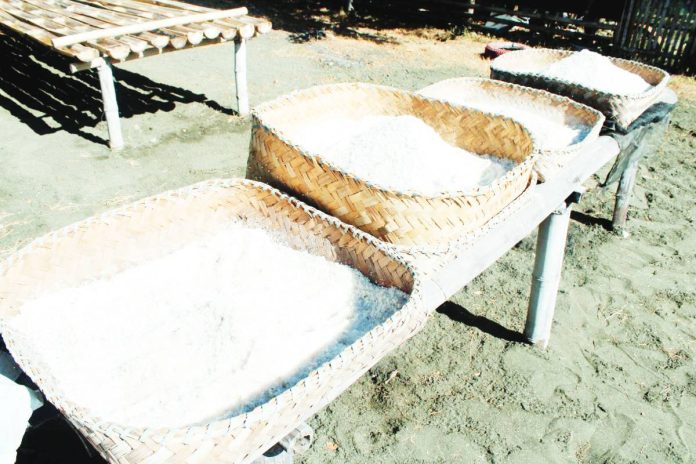
ILOILO City — Aiming to break the country’s heavy dependence on imported salt and revive a fading local industry, the Bureau of Fisheries and Aquatic Resources (BFAR) in Western Visayas has launched a P7.33-million Salt Industry Project (SIP) to boost production, improve quality, and restore traditional salt-making across the region.
The Philippines continues to rely on imports for 99 percent of its salt supply, exposing a critical gap in local production.
BFAR Region 6 director Remia Aparri said the program is designed to address this imbalance by strengthening domestic output while creating new livelihood opportunities for fisherfolk.
“Given our reliance on imported salt, our primary objective is to boost local production, which will not only provide additional livelihood opportunities for our fisherfolk but also enhance the quality of our salt products,” Aparri emphasized.
Current salt production in Western Visayas stands at only 5,447 metric tons — enough to meet just 33 percent of the region’s household requirements.
Nationally, demand for salt for human consumption alone is estimated at 16,371 metric tons, excluding industrial use, further underscoring the supply gap.
Under the SIP, BFAR-6 will provide targeted support to nine fisherfolk beneficiaries across the region through the distribution of modern equipment and essential materials to improve efficiency and product quality.
Western Visayas currently ranks third in national salt production, behind Region 4B (Occidental Mindoro) and Region 1 (Ilocos Region), but contributes less than 10 percent to the country’s total supply.
“In light of our objectives under the SIP, we are not only targeting an increase in local salt production, but we also want to shift consumer preferences towards locally made salt,” Aparri stated.
She acknowledged that changing consumer behavior remains a challenge, as many Filipinos have long preferred imported salt, often perceived to be of higher quality.
To address this, BFAR-6 is rolling out modernization measures, including the use of High-Density Polyethylene (HDPE) materials for better packaging, construction of improved storage facilities, and training on compliance with the Food Safety Act to ensure product safety and competitiveness.
Guimaras remains a key salt-producing province in the region, while Iloilo and Antique continue traditional salt-making activities, particularly during the summer months. Negros Occidental, once a major contributor, is now part of the Negros Island Region following recent administrative changes.
“Our commitment to investing in local salt production transcends mere economic strategy; it is a step toward self-reliance and the assurance of food security for our communities,” Aparri stressed.
With the peak production season approaching, BFAR-6 is banking on the program to jumpstart a long-declining industry and position locally produced salt as a viable and competitive alternative in the domestic market./PN