
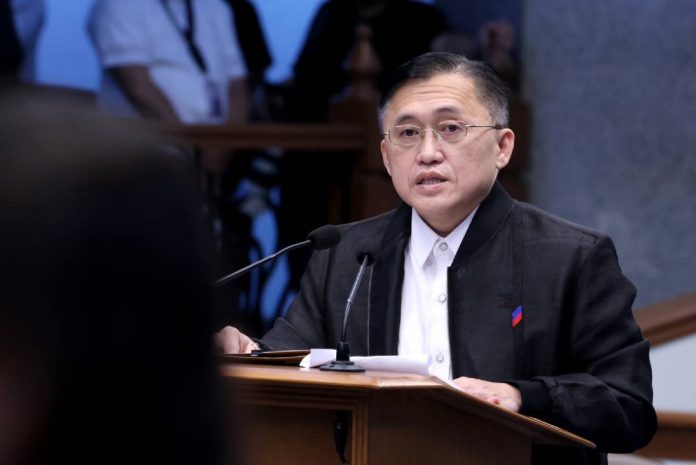
Senator Christopher “Bong” Go welcomed the ratification of the bicameral conference committee report on Senate Bill Nos. 1894 and 8476, measures seeking to enhance Republic Act No. 10931, or the Universal Access to Quality Tertiary Education Act, by strengthening the Tertiary Education Subsidy and improving support for students from poor and vulnerable households.
Go is one of the authors of SBN 1894, which was filed on February 23, 2026. The Senate ratified the bicameral conference committee report on June 17.
The proposed amendments are intended to refine the implementation of the free tertiary education law, particularly the allocation and reach of the Tertiary Education Subsidy. The ratified measure institutionalizes automatic TES eligibility for Senior High School graduates from Pantawid Pamilyang Pilipino Program households, expands allowances for essential student needs, and requires state universities and colleges, local universities and colleges, and technical-vocational institutions to adopt Equity and Inclusion Plans for disadvantaged learners.
Go said the measure is consistent with his long-standing advocacy of making education more accessible to poor Filipino families, especially students who continue to struggle with expenses beyond tuition.
“Para sa akin, dapat masigurado natin na ang tulong sa edukasyon ay napupunta sa mga estudyanteng tunay na nangangailangan. Libre nga ang tuition, pero kung walang pamasahe, pagkain, gamit, o tirahan, mahihirapan pa rin ang bata na makatapos,” Go said.
The context of the bill is rooted in findings cited by the Second Congressional Commission on Education, which found gaps in the targeting of TES assistance. EDCOM 2 reported that the share of TES beneficiaries from Listahanan and 4Ps households declined from 70.73 percent in 2018 to 22.89 percent in 2022. It also cited 2024 data showing that only 1.23 percent of 4Ps Senior High School completers accessed TES as first-year beneficiaries.
The measure directly responds to those gaps by prioritizing students from Listahanan households according to estimated per capita household income and by guaranteeing TES support for Senior High School graduates from 4Ps households who are accepted into qualified higher education or technical-vocational institutions.
“Ang edukasyon ang isa sa pinakamahalagang paraan para makaahon ang isang pamilya sa kahirapan. Kaya dapat malinaw ang sistema, mabilis ang proseso, at ang batayan ay pangangailangan ng estudyante, hindi palakasan o koneksyon,” the senator said.
Under the reconciled proposal, TES support may cover books, supplies, transportation, computer or laptop rental or purchase, room and board, disability-related expenses, and other education-related needs. The measure also provides additional support for learners with disabilities and requires regular reviews of TES amounts to respond to rising education costs.
The bill also requires SUCs, LUCs, and state-run technical-vocational institutions to develop and publicly disclose Equity and Inclusion Plans. These plans are intended to set contextual admissions criteria and equity targets for learners from disadvantaged backgrounds, including first-generation college students, persons with disabilities, and learners from geographically isolated and disadvantaged areas.
Go emphasized that public funds for education assistance must be implemented with proper safeguards, clear rules, and accountability mechanisms.
“Pondo ito ng taumbayan, kaya dapat makarating ito nang tama, maayos, at mabilis sa mga estudyanteng dapat makinabang. Dapat malinaw ang proseso at may pananagutan ang lahat ng nagpapatupad,” Go said.
The senator also noted that support for tertiary education should not be limited to tuition alone, saying many poor students face daily expenses that can still force them to delay or abandon their studies.
“Maraming estudyante ang gustong makatapos pero kinakapos sa araw-araw na gastusin. Kung kaya nating tulungan sila ngayon, gawin natin. Ang tulong sa edukasyon ay tulong sa pamilya at sa kinabukasan ng kabataan,” he said.