



ILOILO City – Brown spot remained the leading rice disease in Western Visayas in May, while stem borer damage and worsening weed infestation continued to pose risks to standing rice crops, according to the latest surveillance report of the Department of Agriculture’s Regional Crop Protection Center (RCPC).
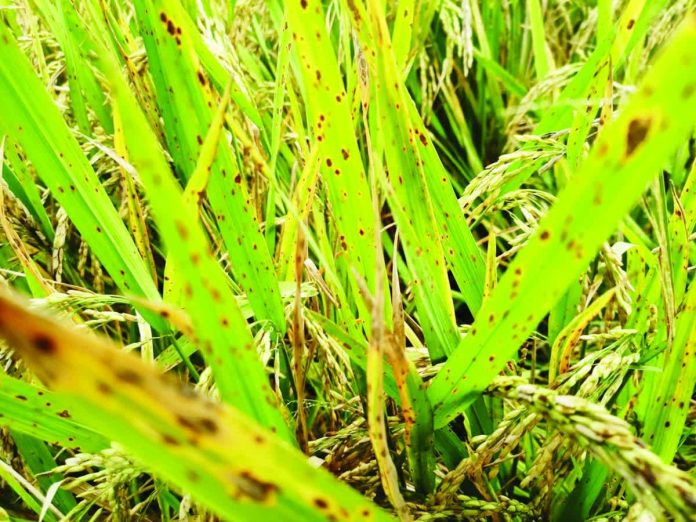
The May 2026 Rice Pest and Diseases Monthly Bulletin showed that brown spot registered the highest disease incidence in the region at 6.28 percent, followed by bacterial leaf blight at 1.25 percent and sheath blight at 0.70 percent.
RCPC said brown spot has been increasing since March, making it the primary disease requiring close attention. The disease is commonly associated with poor soil fertility, inadequate crop nutrition, drought stress and maturing rice plants.
Meanwhile, bacterial leaf blight continued to decline compared with previous months, while sheath blight remained low and did not indicate widespread infection.
The findings were based on inspections conducted in 155 rice fields under the Pest and Disease Risk Identification and Management (PRIME) project.
Most of the monitored farms, equivalent to 89 percent, had already been harvested or had no standing rice crop, leaving only a small number of fields still in the vegetative, reproductive or ripening stages.
Among insect-related problems, whitehead injury caused by stem borers posted the highest incidence at 3.54 percent, followed by deadheart damage at 0.92 percent and rice bug infestation at 0.61 percent.
The agency noted that the increase in whitehead injury points to greater stem borer activity in late-season rice fields, particularly as crops reach heading and grain-filling stages. Deadheart incidence eased in May after rising in April, suggesting that new infestations had slowed.
Other major insect pests, including brown planthoppers, green leafhoppers, rice black bugs and rice green bugs, remained at very low levels, with the bulletin reporting no signs of a regional outbreak.
The report likewise highlighted a steady rise in weed infestation. Regional weed cover climbed to 17.5 percent in May, exceeding the 5-percent level that could already result in significant yield losses if left unmanaged.
According to the RCPC, heavy weed growth competes with rice plants for water, nutrients and sunlight while providing shelter for pests and disease-causing organisms.
Rat damage remained insignificant at 0.11 percent, a sharp decline from April, indicating that current control measures appear to be effective.
Province-specific monitoring showed Iloilo posting among the highest levels of weed cover at 19.49 percent, along with 7.99 percent brown spot incidence, 5 percent whitehead damage, 1.15 percent deadheart damage and 1.12 percent bacterial leaf blight.
Antique recorded the region’s highest weed cover at 20 percent, while Capiz continued to report brown spot as its dominant disease. Aklan logged relatively low levels of leaf blast and brown spot, while Guimaras had no monitoring data for the month.
The RCPC urged farmers to intensify field scouting, adopt balanced fertilization, use resistant rice varieties whenever available and implement timely weed management. It also encouraged continued use of integrated pest management strategies and regular field monitoring to minimize crop losses.
The monthly surveillance is conducted under the PRIME program, which provides early warning information on rice pests and diseases to help farmers make timely crop protection decisions across Western Visayas./PN