

[av_one_full first min_height=” vertical_alignment=” space=” custom_margin=” margin=’0px’ padding=’0px’ border=” border_color=” radius=’0px’ background_color=” src=” background_position=’top left’ background_repeat=’no-repeat’ animation=”]
[av_heading heading=’Councilors ban ‘loud’ mufflers’ tag=’h3′ style=’blockquote modern-quote’ size=” subheading_active=’subheading_below’ subheading_size=’15’ padding=’10’ color=” custom_font=”]
BY GLENDA SOLOGASTOA
[/av_heading]
[av_textblock size=” font_color=’custom’ color=”]
INSERT DATE HERE!
[/av_textblock]
[av_textblock size=” font_color=” color=”]
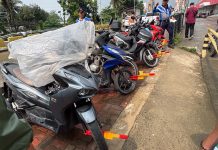
ILOILO City – The Sangguniang Panlungsod (SP) unanimously approved an ordinance banning improvised mufflers that produce excessively loud sounds in both public and private motor vehicles.
The ordinance prohibiting the sale and use of modified mufflers was authored by Councilor Joshua Alim. He cited public complaints against the “noise pollution” from modified mufflers.
During yesterday’s SP regular session, the committee on police matters chaired by Councilor Jeffrey Ganzon recommended the proposed ordinance’s approval.
Sound reaching 90 decibels should already prompt the apprehension of vehicles using modified mufflers, according to Ganzon.
His committee conducted two hearings on Feb. 27 and April 7. These were attended by owners of big bikes, leaders and members of transport groups, tricycle associations and muffler installers.
“The City Environment and Natural Resources Office (CENRO) has no noise meter but an engineer volunteered to donate one once the ordinance is passed,” said Ganzon.
A muffler filters sound and the gas emission that comes from a motor engine.
At the public hearings, CENRO representatives said that under Presidential Decree 984 or the Pollution Control Law, the maximum decibel in industrial areas is 75.
“A Land Transportation Office administrative order, meanwhile, allows up to 115 decibels away from the source, but 115 decibels is too loud. However, this is tolerated because of the absence of a noise machine,” said Ganzon.
The country has several laws against noise pollution. Aside from Presidential Decree 984 that prevents, abates and controls different types of pollution, including noise, there’s Republic Act 8749 or the Clean Air Act that regulates and controls emissions — defined as “any air contaminant, pollutant, gas stream or unwanted sound from a known source which is passed into the atmosphere.”
There’s also Presidential Decree 1152 or the Philippine Environmental Code that establishes the standards for acceptable noise levels for communities as well as for noise-producing equipment.
Under Republic Act 8749, the Department of Environment and Natural Resources has sufficient powers to prescribe the implementing rules on — and penalize violations of — noise emission standards, whether for “stationary sources” like buildings, factories, facilities or installations or for motor vehicles.
The Department of Transportation and Communications, on the other hand, has been authorized not only to test motor vehicles for compliance with noise emission standards but also to apprehend and penalize violators./PN
[/av_textblock]
[/av_one_full]