



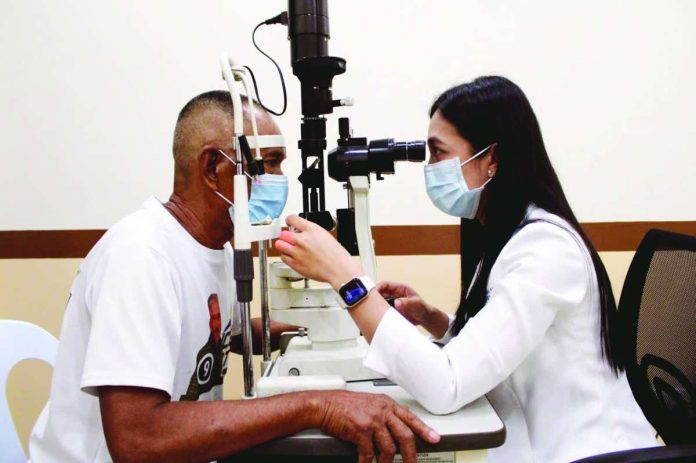
ILOILO City — Diabetic patients are being urged to undergo eye examinations immediately after diagnosis as doctors warn that damage to the retina can silently progress for years before symptoms emerge — and may eventually lead to irreversible blindness.
The warning comes as the government-run Western Visayas Medical Center (WVMC) in Mandurriao, Iloilo City recorded 726 consultations for diabetic retinopathy over an 18-month period — 559 in 2025 and another 167 from January to June 2026.
Dr. Mary Katherine Francia, head of WVMC’s Department of Ophthalmology, stressed that early detection is critical because patients can still have apparently normal vision even when diabetes has already begun damaging the tiny blood vessels of the retina.
Diabetic retinopathy is a progressive complication of diabetes in which prolonged high blood sugar damages the microvascular network supplying the retina, the light-sensitive nerve tissue at the back of the eye.
In its early stages, however, the disease is frequently asymptomatic.
“If it stays within the wall, it functions like a localized bruise — a lagob,” explained Dr. Francia.
“At this point, the patient’s sight is not blurry yet,” she added.
The absence of early warning signs makes regular eye screening particularly important for people with diabetes.
Francia said newly diagnosed diabetic patients should be referred for baseline ophthalmic screening instead of waiting for blurred vision or other symptoms before seeking medical attention.
“Early detection can prevent far more severe complications down the line, especially since vision is so fundamental to how we interact with the world,” Dr. Francia emphasized.
DAMAGE BUILDS OVER TIME
Francia explained that prolonged exposure to high blood sugar gradually damages the lining and structural integrity of blood vessels throughout the body, particularly the tiny vessels found in organs.
“Diabetes damages the lining of blood vessels everywhere,” said Dr. Francia.
“That’s why it also severely affects the kidneys — many diabetic patients end up on dialysis because the kidney is essentially composed of tight clusters of tiny blood vessels. High sugar destroys anything built on microvessels,” she added.
She likened healthy retinal blood vessels to smooth pipes that deteriorate as diabetes progresses.
“Instead of remaining smooth, the blood vessels begin to look like old, corroded water pipes in a home,” Dr. Francia noted.
“They become brittle, structural integrity degrades, and blood and fluid begin to leak out,” she added.
As the vessels deteriorate, the retina can become deprived of oxygen and nutrients, producing damaged areas and tiny hemorrhages.
The condition becomes more dangerous when fragile blood vessels rupture and blood spills into the vitreous, the clear gel occupying the center of the eye.
Such bleeding, known as vitreous hemorrhage, can block the passage of light and cause vision to suddenly darken or become severely clouded.
“If the bleeding is minor, you might be fortunate enough for the body to gradually reabsorb the blood on its own,” Dr. Francia said.
“But if it fails to clear, surgical intervention becomes mandatory,” she stressed.
YEARS BEFORE SERIOUS DAMAGE
Advanced diabetic retinopathy generally does not develop immediately after a person becomes diabetic.
For patients whose blood sugar remains poorly controlled, serious complications may take around 10 to 15 years from the time of diabetes diagnosis to manifest.
But Francia said strict blood sugar management can dramatically slow the progression of the disease.
“If your blood sugar is controlled, progression slows down immensely,” emphasized Dr. Francia.
“I have patients who have lived with diabetes for 20 to 25 years without ever developing retinopathy. They achieve this because they take their daily medications faithfully and manage their blood sugar strictly,” Dr. Francia shared.
She stressed that diabetes remains the most common cause of the type of retinal bleeding associated with the condition.
“This doesn’t happen if you don’t have diabetes. Well, there are other diseases that can cause bleeding here, but the most common is diabetes,” she said.
As retinal damage advances, patients may experience dark spots, streaks or floaters, blurry or fluctuating vision, impaired color perception, dark patches in their central vision and, ultimately, partial or complete vision loss.
DAMAGE MAY BE IRREVERSIBLE
Diabetic retinopathy cannot simply be reversed once serious retinal damage has occurred, making prevention, early detection and proper diabetes management crucial.
Patients are advised to undergo annual comprehensive dilated eye examinations, maintain proper blood sugar levels, and control blood pressure and cholesterol, which can further strain damaged retinal vessels.
Advanced cases may require laser photocoagulation to seal leaking vessels and prevent abnormal blood vessel growth or vitrectomy to remove blood-clouded vitreous gel and repair retinal damage.
Even surgery, however, cannot guarantee that an advanced disease will stop progressing.
“Although no guarantees that the progression will stop… sometimes if it’s very advanced, then even if we do surgery, it still progresses,” Dr. Francia said.
Francia said patients with complicated diabetic eye disease are best managed by retina specialists, ophthalmologists who undergo advanced fellowship training in diseases involving the retina and vitreous.
Because diabetes can affect people from childhood through old age, Francia stressed that comprehensive eye examinations should begin upon diagnosis rather than only after visual problems develop.
The message for diabetic patients, she said, is simple: protecting eyesight begins long before vision starts to fail./PN