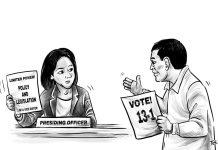


STEPPING back to look at this situation objectively requires the same calm, balanced evaluation that seasoned educators use every single day when managing a chaotic school environment. A fair school principal does not ignore a major case of academic dishonesty or a missing school budget just because the roof of the main gymnasium is leaking, nor do they cancel classes to focus exclusively on fixing a wall. Good management requires looking at the entire picture, seeing how the pieces connect, and refusing to let one crisis excuse another.
When we look at the messy history of our national infrastructure projects without partisan blinders, it becomes clear that the long trail of substandard concrete and suspicious contracts does not belong to just one political family.
A truly independent, thorough investigation into our drainage budgets would likely expose structural failures stretching across several past administrations, which means that addressing both the infrastructure mess and the political trial serves the public interest rather than the shifting fortunes of rival political dynasties.
The real danger of swallowing this either-or narrative is that it trains citizens to accept a broken, compromised system as long as they get a few crumbs of temporary relief.
When political networks tell teachers, workers, and commuters to ignore institutional transparency for the sake of immediate concrete pouring, they are quietly asking the public to permanently lower their expectations of what a government should be. It turns the relationship between the taxpayer and the state into a transactional compromise, suggesting that a developing country must choose between honest leaders and dry streets.
This low bar ensures that neither problem ever gets fixed in a meaningful way. A political class that is completely excused from constitutional oversight because it claims to be busy building roads will inevitably end up building roads that wash away in three months, simply because there is no one left with the power to double-check the thickness of the cement.
Ultimately, a country that wishes to progress cannot allow its national attention span to be divided by those who fear transparency. The public must reject the artificial choices manufactured by individuals who benefit from institutional blindness and weak public memory. National growth is not a single-file line where justice has to wait quietly behind public works; it is a shared space where physical safety and administrative honesty keep each other standing.
A community can withstand a massive typhoon if its infrastructure is solid, just as a democracy can survive a political crisis if its institutions remain strong and trustworthy. The ultimate test of our maturity as a voting public is our firm refusal to compromise on either front, ensuring that while the mud is cleaned from our school classrooms, the deep-seated culture of impunity is finally cleared from our public offices.
***
Doc H fondly describes himself as a ”student of and for life” who, like many others, aspires to a life-giving and why-driven world grounded in social justice and the pursuit of happiness. His views do not necessarily reflect those of the institutions he is employed or connected with./PN