



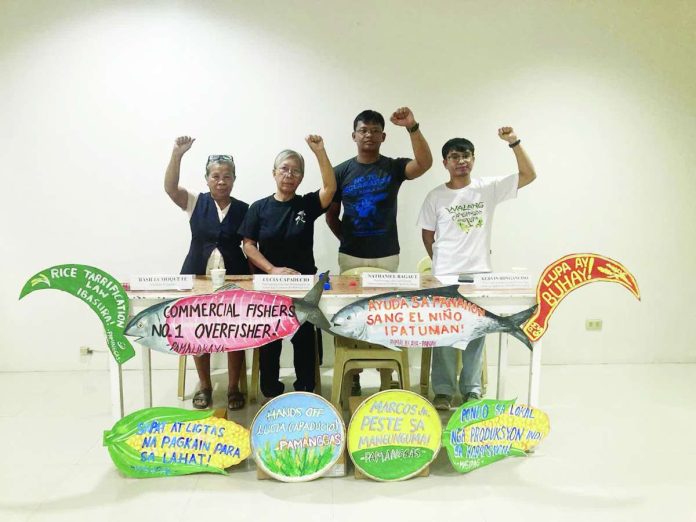
ILOILO — With agricultural losses nationwide already reaching P6.54 billion and rice production projected to decline by 700,000 metric tons, farmers and fisherfolk in Iloilo Province are demanding government intervention, warning that a super El Niño could trigger widespread food shortages, soaring prices and deeper poverty across Western Visayas.
Progressive agricultural and fisheries organizations called for a P50,000 production subsidy for every small-scale farmer and fisherfolk household, accusing the government of failing to adequately prepare for a climate crisis that threatens both food production and the livelihoods of thousands of rural families.
The warning came as farmers, fisherfolk and food security advocates gathered during the observance of World Food Day on October 16 to highlight the mounting economic and agricultural consequences of prolonged dry conditions.
Citing mid-October estimates from the National Disaster Risk Reduction and Management Council (NDRRMC), the groups said agricultural damage nationwide had reached P6.54 billion.
The Department of Agriculture also projected a 700,000-metric-ton reduction in palay production by the end of 2026, raising concerns over the country’s rice supply and the possibility of further increases in food prices.
FARMERS FACE MOUNTING LOSSES
Lucia Capaducio, chairperson of Paghugpong sang mga Mangunguma sa Panay kag Guimaras (PAMANGGAS), said farmers who planted early in June were generally able to secure satisfactory harvests in October.
However, those whose planting schedules were disrupted by unpredictable weather conditions suffered crop failures and drought-related losses.
Capaducio said farmers were already struggling with low farmgate prices of palay, ranging from P19 to P21 per kilogram, even as retail rice prices remained between P50 and P60 per kilogram.
She warned that a further decline in palay prices to below P15 per kilogram would prevent farmers from recovering their production expenses, pushing more agricultural households into debt and poverty.
The widening disparity between farmgate and retail prices, the group argued, underscores the continuing difficulties confronting rice producers despite government policies intended to make the staple more affordable.
PAMANGGAS also questioned the effectiveness of the Rice Tariffication Law in protecting farmers while ensuring affordable rice for consumers.
FISHERFOLK HIT BY MULTIPLE CRISES
The fisheries sector is confronting similarly difficult conditions, with municipal fisherfolk reporting daily catches of only one to five kilograms.
Nathaniel Bagaut of Pambansang Lakas ng Kilusang Mamamalakaya ng Pilipinas (PAMALAKAYA)-Panay said fishing communities were already reeling from the combined effects of the southwest monsoon, successive typhoons, declining fish catches and increasing fuel prices.
The anticipated intensification of El Niño, he warned, could further undermine their livelihoods.
Bagaut also raised concerns over the continued intrusion of commercial fishing vessels into municipal waters, which he said worsens the depletion of fishery resources.
He cited difficulties encountered by the Dumangas Bantay Dagat Task Force in apprehending commercial fishing vessels that evade maritime enforcement operations.
The group also pointed to estimates indicating that 88 percent of Philippine fishing grounds are overfished, underscoring the vulnerability of municipal fishing communities to additional environmental pressures.
FARMLANDS DISAPPEARING
Meanwhile, Basilia Moquite of the rural women’s organization Amihan-Leganes warned that agricultural communities were confronting not only extreme weather but also the continuing conversion of productive farmland into residential subdivisions.
She said farmers in Leganes had attempted to adapt by storing water and cultivating alternative crops, but these measures offered limited protection against worsening drought and the steady disappearance of agricultural lands.
“Without our local and primary food producers, the entire Filipino population will go hungry,” Moquite stressed.
The organization warned that continued land conversion could further weaken local food production at a time when the country needs to strengthen its agricultural capacity against climate-related disruptions.
GOVERNMENT INACTION QUESTIONED
Kervin Bonganciso of Magsasaka at Siyentipiko para sa Pag-unlad ng Agrikultura (MASIPAG) Visayas criticized what he described as the government’s inadequate preparations despite early warnings from the Philippine Atmospheric, Geophysical and Astronomical Services Administration (PAGASA).
He said authorities had been aware of the impending El Niño since April, providing sufficient time to introduce measures to cushion its impact on agricultural production and food prices.
Bonganciso warned that declining domestic production, increasing dependence on imported food and persistent inflation could combine to create a more serious food security crisis.
The groups maintained that earlier government intervention could have reduced the economic damage now confronting food producers.
P50,000 SUBSIDY SOUGHT
To prevent further deterioration of the agricultural and fisheries sectors, the organizations urged the government to immediately provide a P50,000 El Niño production subsidy to small-scale farmers and fisherfolk.
They also demanded the repeal of the Rice Tariffication Law and the passage of the proposed Rice Industry Development Act, which they described as a more farmer-oriented alternative.
Other proposed measures include repealing the Oil Deregulation Law, removing excise and value-added taxes on petroleum products, and restoring stronger legal protections for municipal fisherfolk against commercial fishing operations.
The organizations also called for policies that would safeguard local fisheries and strengthen the capacity of small food producers to withstand extreme weather conditions.
They warned that without immediate and substantial government assistance, the worsening dry spell could accelerate agricultural losses, deepen rural poverty and increase the country’s dependence on food imports./PN