


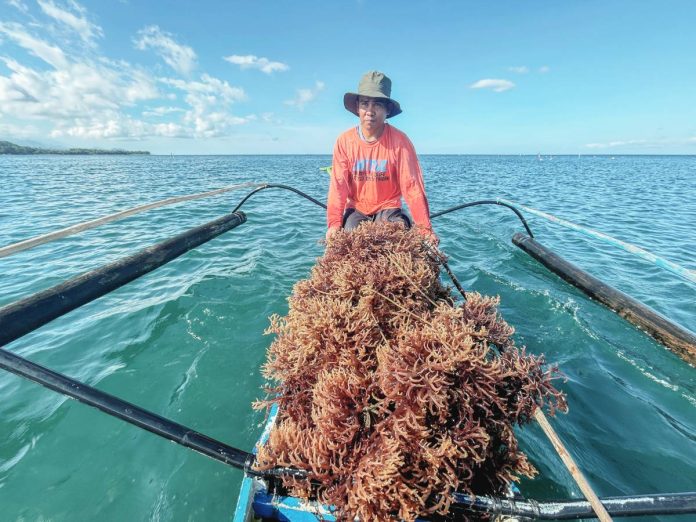
ANTIQUE — In a bid to strengthen local seaweed production and support farmers facing persistent seedling shortages, the Southeast Asian Fisheries Development Center–Aquaculture Department (SEAFDEC/AQD) has launched a seaweed grow-out project in Pandan, Antique.
Rolled out in November 2025, the initiative utilizes advanced tissue-cultured plantlets designed to improve the resilience of seaweed crops against environmental stressors.
The project is a collaborative effort among SEAFDEC/AQD, the local government unit of Pandan, and the Department of Agriculture’s Bureau of Fisheries and Aquatic Resources in Western Visayas (DA-BFAR 6).
The partnership seeks to address the long-standing issue of seedling scarcity—a major constraint in the seaweed farming industry that affects productivity and farmers’ income.
SEAFDEC/AQD Chief Dan Baliao underscored the importance of the initiative in bridging critical gaps in seaweed production.
“By supplying farms with laboratory-grown seedlings, we are offering a sustainable solution that can better withstand environmental stressors compared to traditional cultivars,” Baliao said.
The plantlets are produced at SEAFDEC/AQD’s Seaweed Laboratory at its Tigbauan Main Station. These laboratory-grown seedlings are more robust and show increased resistance to “ice-ice” disease—a condition caused by environmental stress that leads to the whitening and brittleness of seaweed.
Initial results have been encouraging. Within the first 45 days of cultivation, the project recorded growth rates ranging from 5% to 7.23% per day.
As of April, total harvest has reached 1.02 metric tons. Of this, 50 kilograms have been distributed to farmers in Palawan through BFAR-Mimaropa, while additional volumes are earmarked for transport to SEAFDEC/AQD’s Igang Marine Station in Guimaras for further research.
Beyond the grow-out project, SEAFDEC/AQD, in partnership with DA-BFAR, is also working to establish nursery systems in key seaweed farming areas nationwide. The initiative aims to ensure a steady supply of high-quality planting materials and reduce dependence on traditional seed sources.
In the long term, the program seeks to boost seaweed production, increase farmers’ incomes, and promote sustainable aquaculture practices, particularly in coastal communities vulnerable to the impacts of climate change.